
Reviewed · KYOTO TOURS
Kyoto: Gion Evening Walk with Hidden Gems, Geisha & Sake
Gion after dark is a different place. The tour leads you past wooden tea houses, quiet lanes, temple gates, and lantern-lit streets when much of the daytime crowd has gone home. I especially like the small-group limit of 10 and the chance to ask plain, direct questions about Geiko, Maiko, Shinto, and Kyoto life.
I also like the local sake and photo help, two small touches that make a short walk feel more personal. The trade-off is that 90 minutes goes by quickly, so this is a highlights walk rather than a detailed temple visit. You also need to arrive on time, since the group may leave promptly.
Key points before you book
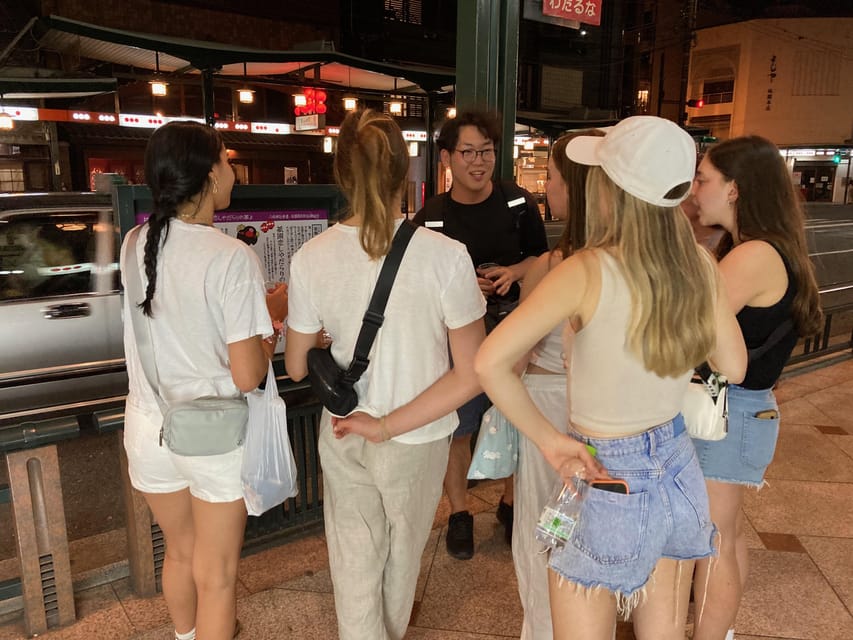
- Gion after sunset: See Hanamikoji Street, Ninenzaka, and nearby shrines under lantern light and with fewer people around.
- A genuinely small group: The maximum group size is 10, though some departures may be smaller or even private.
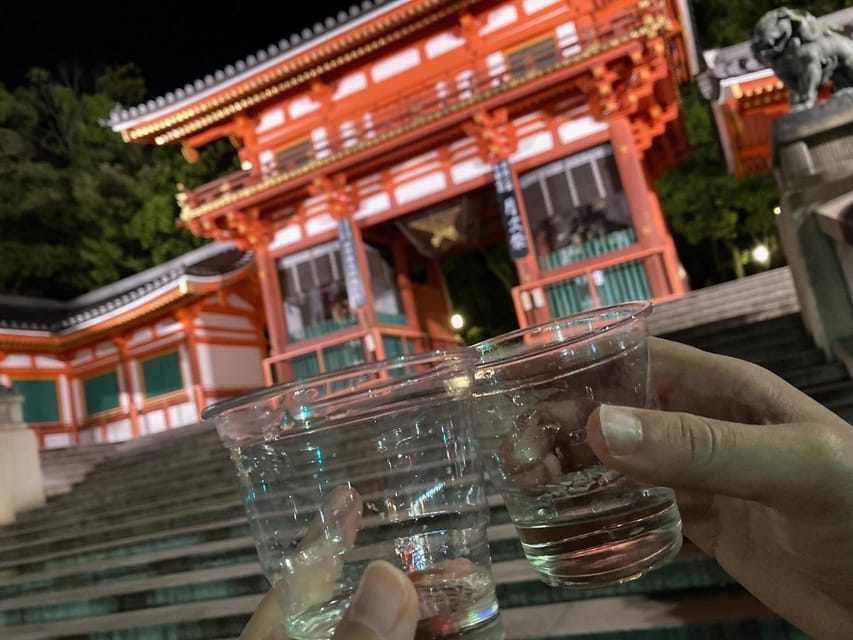
- Sake included: Enjoy a cup of local sake during the walk, while keeping your drinking responsible in public and sacred areas.
- Five important stops: The route includes Gion, Yasui Kompira-gū Shrine, Hōkan-ji Temple and Yasaka Pagoda, Ninenzaka, and Yasaka Shrine.
- Friendly local guiding: Guides such as Shumpei and Nick have been praised for warmth, humor, patience, and useful cultural explanations.
- Useful for first-time Kyoto visitors: You get orientation, photos, evening atmosphere, and suggestions for what to do next.
Why Gion works best after dark
Gion is famous for its Geiko and Maiko traditions, but a daytime visit can feel crowded and hurried. In the evening, the district’s wooden facades and narrow streets take on a softer mood. Lantern light picks out the details, and the quiet asks you to slow down.
That quiet matters. You are walking through a living neighborhood, not an outdoor stage set. The reminders to keep voices low in residential and sacred areas are not mere formalities. They help you see Gion with respect and avoid treating private streets as a photo studio.
The walk is led in English and has a conversational style. Instead of filling every minute with a formal speech, your guide can respond to what interests you. You can ask about Geiko and Maiko customs, Kyoto’s religious traditions, food, places to visit next, or even anime, as one guide did during a particularly wide-ranging conversation.
Guides named Shumpei and Nick have received especially warm praise for being funny, patient, welcoming, and easy to talk with. That personal approach is a major part of the experience. The same route would feel less useful if it were only a series of photo stops with names attached.
More Hidden Gems Walks in Kyoto
- Kyoto Geisha Walking Tour: Gion District & Hidden Gems
★ 4.7 · 3,273 reviews - Private Kyoto Tour with a Local, Highlights & Hidden Gems, Personalised
★ 5.0 · 1,543 reviews - Arashiyama Bamboo Forest & Hidden Gems Bike Tour (Early Bird)
★ 5.0 · 613 reviews
Meeting at Shijo Kiyamachi
The meeting point is at Shijo Kiyamachi, near 90-3 Shinchō. Look for a guide holding an Otatrip Guide sign between McDonald’s and the Japanese restaurant Kikunoi Roan, a little south along Kiyamachi Street.
Give yourself time to find the exact spot. The directions involve nearby businesses and a street position rather than a famous monument, so arriving at the last minute is risky. The tour can depart on schedule if other people are ready, and late arrivals may miss the start.
Once the group gathers, expect a walking tour lasting about 70 to 90 minutes, with the full scheduled duration listed as 90 minutes. Comfortable shoes are important. The route includes cobblestones, slopes, and several stops where you will be on your feet.
This is not a good choice if back problems make extended walking difficult. Smoking is not allowed during the activity.
Hanamikoji Street and the world of Geiko
The first main area is Gion, including Hanamikoji Street, Kyoto’s best-known Geiko street. Traditional wooden tea houses line the route, giving you a close look at the architecture and atmosphere linked with Kyoto’s entertainment quarters.
Your guide explains the difference between Geiko and Maiko and places those traditions in the wider story of Gion. The value here is context. Without it, a closed tea house can look like a pretty old building. With a guide, you begin to understand why the district has such a careful social code and why respectful behavior matters.
You might see a Geiko or Maiko during the walk, but this is not promised. One person on an April tour saw two actual Geishas, yet sightings depend on timing, chance, and the conduct of everyone nearby. Do not treat an encounter as a goal or interrupt anyone for a photograph.
The guide’s presence helps you look without intruding. You can also ask for photo assistance at suitable locations, which is useful when you want a picture of yourself against the old streets without stopping strangers.
Yasui Kompira-gū Shrine and its unusual stone
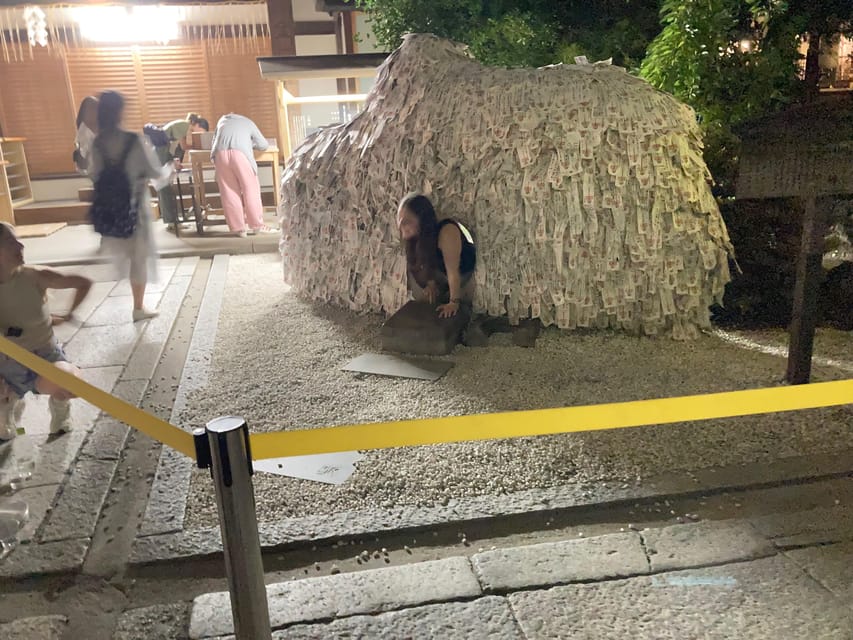
The next stop is Yasui Kompira-gū Shrine, a compact and distinctive Shinto site known for its power stone. People visit to cut bad ties and build good ones, giving the shrine a very different character from a simple scenic stop.
Your guide explains the custom and the meaning behind the stone in plain English. This is one of the most worthwhile parts of the tour because it shows how religious practice in Kyoto can be direct, personal, and tied to everyday worries.
The shrine also adds variety. You are not only walking past famous streets and taking pictures. You are seeing a place with a specific purpose and local tradition. Since the stop is listed at about 10 minutes, expect an introduction and explanation rather than a long period for independent exploration.
As at other sacred locations, lower your voice and follow your guide’s lead. The evening setting makes the shrine feel especially calm, but it also makes respectful behavior more noticeable.
More off-the-list walks in Kyoto:
- Kyoto: Hidden Gems E-Bike Tour with Local Japanese Guide
★ 4.9 · 189 reviews - Kyoto: Gion Hidden Gems & Geisha Culture Tour
★ 4.9 · 126 reviews - Highlights & Hidden Gems With Locals: Best of Kyoto Private Tour
★ 5.0 · 121 reviews - Kyoto: Hidden Gems E-Bike Tour Through Backstreets & Temples
★ 4.9 · 54 reviews
Hōkan-ji Temple and the Yasaka Pagoda
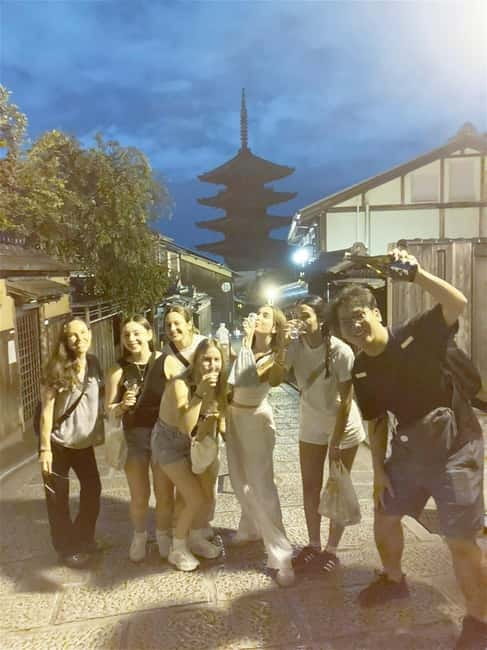
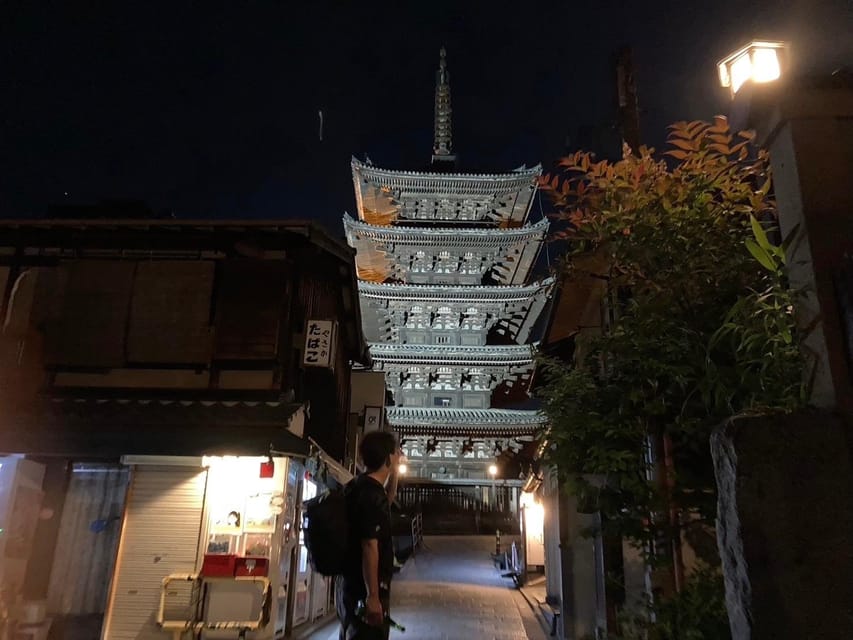
Hōkan-ji Temple is home to Yasaka Pagoda, the five-story landmark that appears in so many Kyoto photographs. At night, the pagoda is lit and can be easier to appreciate without the full daytime crowd.
The stop is mainly for viewing, explanation, and photos. The tour does not promise an extended temple visit or a climb, so set your expectations accordingly. You are seeing the pagoda as part of a moving neighborhood walk, not joining a full temple program.
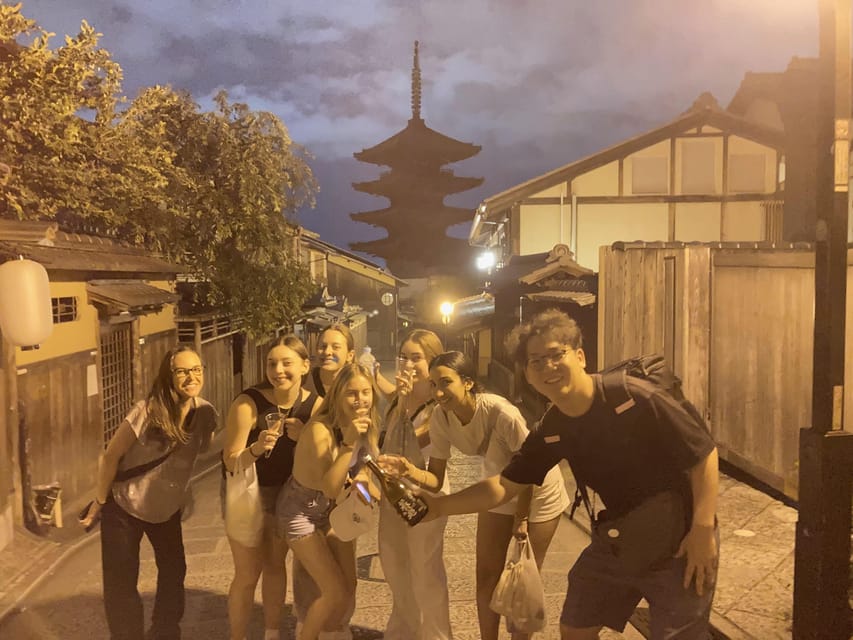
This is likely to be one of your favorite photo points. The old streets around the pagoda give the view its appeal, and the guide can help you frame a shot. Photo assistance is included, but you should still expect ordinary handheld travel photos rather than a professional photography session.
The lighting and quiet can change with weather and the number of people nearby. A rainy evening may sound like a problem, yet wet streets can also make the lantern light more reflective and the area quieter. Bring shoes that feel secure on damp stone.
Ninenzaka, the cobbled slope

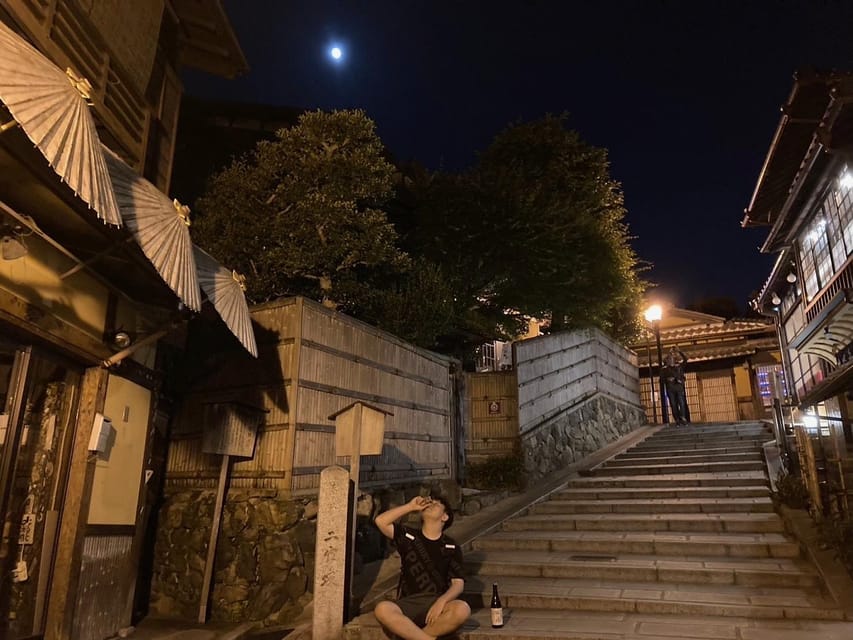
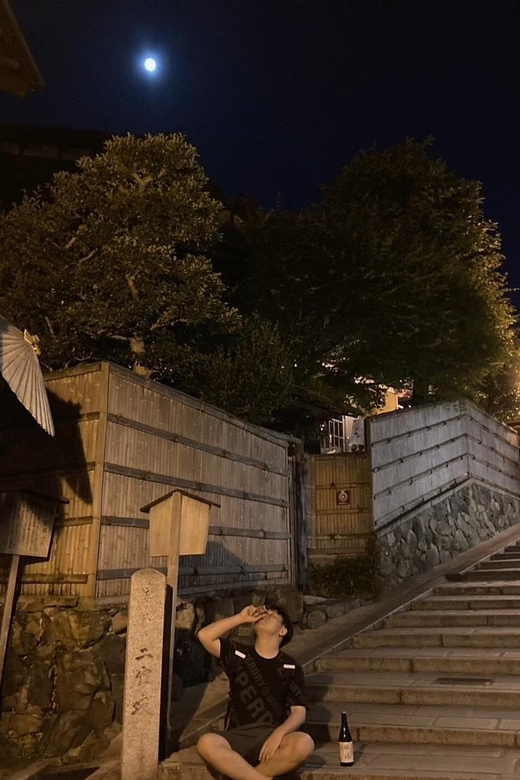
From the pagoda, the walk continues to Ninenzaka, a traditional slope lined with wooden townhouses and old-style storefronts. Its incline and paving make comfortable shoes more than a suggestion.
Ninenzaka is a fine place to understand why Kyoto’s historic districts are best seen slowly. You can notice rooflines, timber details, shop fronts, and the changing view as the lane rises. At night, the slope can feel like a step back in time, though some shops may not be open during your departure.
The setting is photogenic, but do not expect to linger for a long shopping visit. Ten minutes is enough for a brief explanation and pictures, not for browsing every side street. The guide keeps the group moving so you can reach the final stop at Yasaka Shrine.
This compact pace is both a strength and a limit. You cover several important places in one evening without giving up an entire night. If you want to inspect Ninenzaka in detail, return on your own in daylight.
Ending at Yasaka Shrine
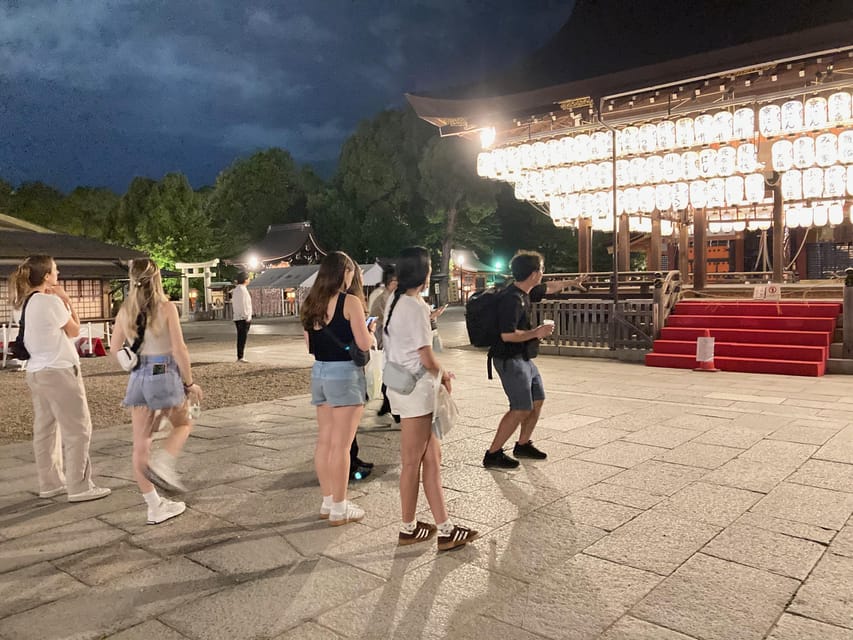
The tour finishes at Yasaka Shrine, a major spiritual landmark associated with Gion and a history of more than 1,300 years. Its location makes sense as the final stop because it ties the entertainment district, temple streets, and Shinto traditions together.
Ending here is also practical. You are not returned to the starting point, so think of the walk as a one-way evening route. The tour information does not provide a return transfer, and the finish is at 八坂神社, Yasaka Shrine.
Use the final moments to ask your guide what to do next. Several people valued being able to discuss food, further sightseeing, and local places in a relaxed way. The guide may be able to point you in a useful direction, but specific restaurant or nightlife recommendations are not guaranteed as part of the formal tour.
The experience can also lead naturally into the rest of your evening. One person enjoyed meeting the group for a drink afterward, but that is an informal possibility rather than an included activity.
How much value do you get for $32?
At $32 per person, this is priced as an affordable short orientation rather than a major half-day excursion. The value comes from combining five well-known locations, a live English-speaking guide, a small group, sake, and photo help in one 90-minute route.
If you walked through Gion alone, you could see several of the same streets and landmarks for no tour fee. The question is what you would miss. Without a guide, you may not understand the power stone at Yasui Kompira-gū, the difference between Geiko and Maiko, or the reason for keeping quiet in certain areas.
The small group improves that value. With no more than 10 people, it is easier to hear explanations and ask questions than on a large coach-style tour. Some departures may be smaller. One person had a private walk after others chose an earlier time, while another joined a group that still felt intimate.
Sake adds a social touch rather than a major financial benefit. It gives the group something to share as you walk and helps the evening feel less formal. The quantity and quality may vary by guide and departure, so book this for the walk and conversation first, not as a sake tasting.
The full rating is listed as 5 from 41 reviews, and the repeated praise centers on the guides. Warmth, humor, patience, organization, cultural explanations, and the ability to make people comfortable come up again and again. That consistency matters more than any single landmark.
What the 90-minute pace feels like
You should expect a brisk but manageable walk, with short explanations at each stop. The route is compact and planned to cover essential parts of Gion rather than give you long free time at every site.
The pace suits you if you want a clear first look at the district before deciding where to return. It may frustrate you if you prefer to stand quietly at each shrine, enter every temple, or spend an hour photographing one street.
A late-night starting time can be useful. One person appreciated fitting the tour around a full day of sightseeing, and this is one of the experience’s practical strengths. Check the available departure times when booking because the exact schedule is not fixed in the information provided.
Rain does not automatically ruin the walk. A wet evening may leave the streets quieter, though you will need suitable footwear and should be ready for outdoor conditions. The tour remains a walking activity, not an indoor alternative.
Who should take this Gion walk?
I would recommend it most strongly for a first visit to Kyoto, especially if you want an easy introduction to Gion after dark. It gives you useful cultural grounding without demanding a full evening or a long lecture.
It also suits solo visitors and couples who want company for a night walk. The small group gives you a chance to meet people, and the sake helps create a friendly mood without turning the activity into a bar crawl.
Photographers will appreciate the lantern-lit streets, Yasaka Pagoda, Ninenzaka, and the guide’s help at key locations. Keep in mind that the guide can assist with photos, but the experience is not designed as a dedicated photography tour.
History-minded visitors should enjoy the links between Gion’s entertainment traditions, Buddhist temple sites, and Shinto shrines. The explanations are in plain English and conversational rather than academic. If you want detailed religious scholarship, you may find the short format too light.
This is less suitable for anyone with back problems or difficulty walking on slopes and cobbles. It is also not ideal if you want a guaranteed Geiko or Maiko sighting, a formal sake tasting, or a lengthy visit inside each religious site.
Small details that make the walk better
Arrive early enough to locate the sign and settle in before departure. The starting point is near recognizable businesses, but Shijo Kiyamachi can be busy and easy to misread when you are watching the clock.
Wear shoes with good support. You will walk through streets, over cobbles, and up or down a slope. Avoid planning an outfit that works only for polished indoor floors.
Keep your voice low near homes and shrines. Ask before taking close photographs of people, and never block a narrow lane for a picture. These habits improve your own experience and help preserve Gion as a real neighborhood.
Treat the sake as a small part of the evening. Drink responsibly, especially while walking, and remember that you are passing through sacred and residential spaces.
Finally, ask questions. The strongest part of this experience is not simply reaching Yasaka Pagoda or Yasaka Shrine. It is having someone like Shumpei or Nick explain what you are seeing, respond to your interests, and help you connect the famous sights.
Should you book this Kyoto evening tour?
Book it if you want a short, friendly, well-priced introduction to Gion with an English-speaking guide, a cup of sake, and a route that covers the area’s major evening sights. The strongest reasons are the small group, the relaxed conversation, and the cultural background that turns attractive streets into meaningful places.
Skip it if you prefer to explore independently, dislike fixed meeting times, or want long visits inside temples and shrines. You can walk much of Gion on your own, but you will give up the guide’s explanations, photo help, and easy social setting.
For most first-time Kyoto visitors, $32 is a fair price for getting your bearings after dark. Just arrive promptly, wear sensible shoes, respect the neighborhood, and think of the tour as a well-guided introduction rather than the final word on Gion.
FAQ
How long does the Gion evening walk last?
The scheduled duration is 90 minutes. The walking portion is described as lasting about 70 to 90 minutes, depending on the route and pace.
What language is the tour offered in?
The live tour guide speaks English.
How large is the group?
The small-group tour is limited to 10 participants. Some departures may be smaller, and a private departure can occur if few people book a particular time.
Where does the tour meet?
The meeting point is Shijo Kiyamachi, near 90-3 Shinchō. Look for an Otatrip Guide sign between McDonald’s and Kikunoi Roan, a little south along Kiyamachi Street.
Where does the tour finish?
The walk finishes at Yasaka Shrine, written as 八坂神社 in the activity information. It does not return to the starting point.
Is sake included?
Yes. A cup of local sake is included for you to enjoy during the walk.
What should I bring?
Bring comfortable shoes. The activity is a walking tour that includes cobbled streets and a sloped section at Ninenzaka.
Can I cancel for a full refund?
Yes. You can cancel up to 24 hours in advance for a full refund. You can also reserve now and pay later, subject to the booking conditions.
More Drinks-Led Nights in Kyoto
- Kyoto Night Foodie Tour in Gion (9+ dishes + 6 Sake tastings)
★ 5.0 · 1,762 reviews - 3-Hour Kyoto Insider Sake Brewery Tour with Tastings & Pairings
★ 5.0 · 917 reviews - Arashiyama Bamboo, Temple, Monkeys, or Secret Sake Brewery
★ 4.8 · 886 reviews - Kyoto: Izakaya Bars Guided Walking Tour
★ 4.9 · 815 reviews
More Geisha Experiences
- Kyoto: Gion Magical Night Walking Tour with Geisha Trivia
★ 4.9 · 2,393 reviews - Kyoto: Gion Geisha District Walking Tour – Stories of Geisha
★ 4.7 · 2,187 reviews - Best of Kyoto: Gion, Geisha, Pagodas & Cobblestones
★ 4.9 · 2,058 reviews - Night Walk in Gion: Kyoto’s Geisha District
★ 4.5 · 2,003 reviews
Just added around Kyoto
- Kyoto: Zen Meditation at a Private Temple with a Monk★ 5.0 · 25 reviews
- Kyoto: Gion Geisha District & Sake-in-Hand Walking Tour★ 5.0 · 37 reviews
- Private Pewter Sake Cup Experience with a Kyoto Artisan★ 5.0 · 31 reviews
- Your Private Vacation Photography Session In Kyoto★ 5.0 · 110 reviews
- Private Guided Traditional Buddhist Cooking in Japan★ 5.0 · 16 reviews
- Kyoto Wagashi(Japanese sweets) Cooking Class near Fushimiinari★ 5.0 · 60 reviews
- Traditional Japanese Music show & Experience Tour in Kyoto★ 5.0 · 57 reviews
- Kyoto:Family-Friendly Kimono & Yukata Experience at WARGO★ 5.0 · 147 reviews
Kyoto Tours, compared.


Fushimi Inari, Kinkakuji, Bamboo Grove 1 Day Bus Tour
Read our review →
Tea Ceremony in a Traditional Tea House in Kiyomizu
Read our review →
Kyoto Geisha Walking Tour: Gion District & Hidden Gems
Read our review →

Gion Magical Night Walking Tour with Geisha Trivia
Read our review →

Gion Geisha District Walking Tour – Stories of Geisha
Read our review →Browse the lists this tour appears in