
Reviewed · KYOTO TOURS
Nara 8hr Private Tour – Kyoto DEP. with Licensed Guide
Nara’s appeal is simple: an enormous bronze Buddha, centuries-old temples, quiet shrine paths, and deer wandering freely through the park. This private day trip lets you choose three or four sites instead of being marched through a fixed schedule, with guides such as Junichi, Taku, Yuka, Ken, and Masaaki bringing different local interests and personalities.
I like the personal planning and the fact that your guide can adjust the day for families, architecture fans, religious history, gardens, or lesser-visited temples. I also like having someone explain train routes, shrine customs, temple art, and the difference between Shinto and Buddhism as you walk. The main drawback is cost: at $201.51 per person, you also pay for transportation, admissions, and lunch.
Key points to know before booking
- Choose three or four Nara sights: Build the day around Tōdaiji, Horyu-ji, Kasuga Taisha, Naramachi, gardens, museums, or quieter temples.
- Meet on foot in Kyoto: The advertised arrangement is a walking pickup within a designated Kyoto area, not a private car.
- Expect a full walking day: The experience lasts about eight hours, with each selected stop planned at roughly 30 minutes in the published schedule.
- Guides shape the experience: Junichi is from Nara, while guides such as Taku, Yuka, Ken, Haru, and Masaaki have received especially strong praise for history, flexibility, and communication.
- Costs add up: Transportation, entrance tickets, food, and personal expenses are not included.
- Best for a private group: Only your party participates, so families and couples can set the pace more easily than on a bus tour.
Why a private day in Nara works so well
Nara was Japan’s capital during much of the Nara Period, from 710 to 794. That gives the city a different feel from Kyoto. Kyoto is famous for elegant later-period temples and refined neighborhoods, while Nara puts early Japanese Buddhism, imperial power, and ancient religious art right in front of you.
The biggest advantage of hiring a guide is not simply finding Tōdaiji. You can locate the temple on a map. The value comes from knowing what you are looking at, why the capital moved here, how Buddhism and Shinto developed side by side, and which smaller hall or statue deserves your attention.
The private format helps here. A guide can spend more time on architecture if that is your interest, or keep explanations shorter for children. One family worked with Ken to shape the day around a teenager’s interests. Another group asked Yuka to include Yakushiji, which lies outside the most familiar Nara Park route.
You should still be realistic about the format. This is not a chauffeured excursion. You meet your guide on foot, use public transportation, and walk between sights. Some past arrangements included hotel pickup or help locating a vehicle at Nara Station, but the stated inclusion is a walking meetup in Kyoto. Confirm your meeting point and transport plan after booking.
More Licensed Guide Tours in Kyoto
- Kyoto 6hr Private Tour with Government-Licensed Guide
★ 5.0 · 1,369 reviews - Kyoto 4hr Private Tour with Government-Licensed Guide
★ 5.0 · 629 reviews - Kyoto: Private Tour with Local Licensed Guide
★ 4.8 · 463 reviews
Tōdaiji and the giant Buddha
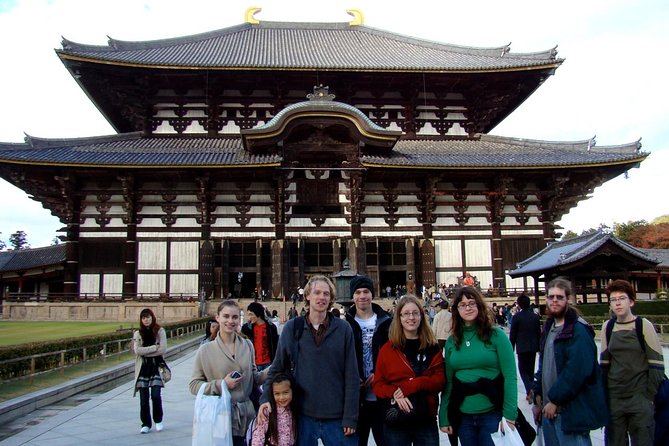
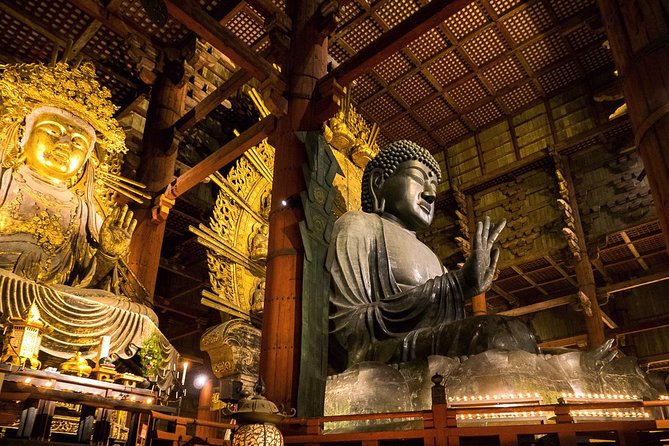
For most people, Tōdaiji is the essential first choice. Founded in 752, this temple was once the head temple for provincial Buddhist temples across Japan. Its Great Buddha Hall houses the enormous bronze Vairocana Buddha, an image created to express protection and unity for the country.
The approach is part of the experience. The Nandaimon Gate gives you a powerful first look at the scale of the complex, and the Great Buddha Hall makes the surrounding visitors seem small. Your guide can help you look past the sheer size and notice the building’s structure, religious purpose, and rebuilding history.
The published schedule allows about 30 minutes here, and that can feel tight if you want to study the Buddha Hall, pause for photographs, and visit nearby halls. A guide can help you move efficiently, but you should tell them if Tōdaiji is your main priority. Admission is not included.
One memorable feature is the hole in a wooden pillar inside the hall. It is said to be the size of the Buddha’s nostril, and squeezing through is associated with good fortune or academic success. It is particularly popular with children and school groups. At busy times, the line can take up much of your visit, so ask your guide if it fits your priorities.
Nara Park and the deer
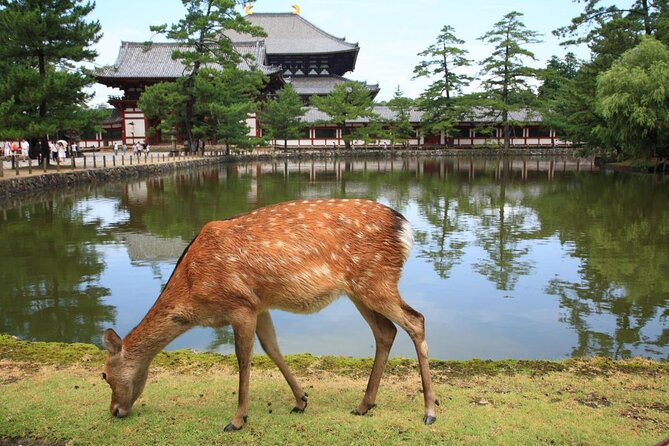
Nara Park was established in 1880 and links many of the city’s major sights, including Tōdaiji, Kasuga Taisha, Kōfuku-ji, and the Nara National Museum. The deer are its most famous residents, and you will see them grazing, resting, and approaching people in search of food.
The deer are part of Nara’s religious tradition, not simply a theme-park attraction. Your guide can explain their connection with Kasuga Taisha and show you how to interact with them respectfully. Bowing to the deer is one of the small pleasures of the day, and families often find this the most memorable part.
Nara Park is free, but food for the deer costs extra. Keep your attention on the animals and finish any deer crackers before walking away. The park is open and spacious, but it can become crowded, hot, or rainy. One summer group found the heat tiring, and another day was wet from morning to afternoon. Comfortable shoes and weather protection matter.
Kasuga Taisha and its forest path
Kasuga Taisha is Nara’s best-known Shinto shrine. It was established when the capital came to Nara and is dedicated to the deity believed to protect the city. Its approach leads through trees and past rows of stone lanterns, creating a quieter mood after the open park.
The shrine gives you a chance to compare Shinto and Buddhist traditions. That comparison is one of the most useful themes for a Nara tour, since temples and shrines often sit close together and have influenced each other for centuries. Guides such as Junichi and Masaaki have been especially appreciated for explaining religious differences and the changing relationship between the two traditions.
The 30-minute schedule suits a focused visit, but it will not cover every sub-shrine or ceremonial area. If you want the full approach, time for prayer, and a slower walk among the lanterns, make Kasuga Taisha one of your main selections rather than adding too many other stops.
More licensed-guide days in Kyoto:
- Private Kyoto Tour with Licensed Guide & Vehicle (Max 15 persons)
★ 5.0 · 417 reviews - Kyoto 8hr Private Tour with Government-Licensed Guide
★ 5.0 · 51 reviews - Kyoto Arashiyama & Sagano Bamboo Private Tour with Government-Licensed Guide
★ 5.0 · 49 reviews - Kyoto Early Morning Private Tour with Government-Licensed Guide
★ 5.0 · 23 reviews
Horyu-ji, Yakushiji, and Nara’s older temples
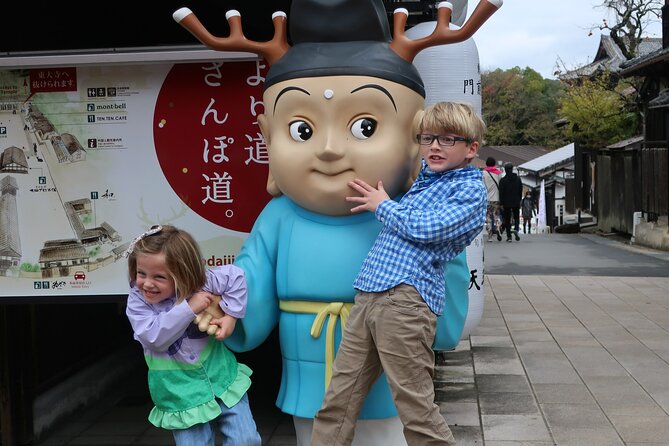
Horyu-ji is the strongest choice for serious students of early Japanese Buddhism. Prince Shōtoku founded it in 607, and the temple contains some of the world’s oldest surviving wooden structures. It sits outside the central Nara Park cluster, so reaching it uses more of your day.
That distance is also its advantage. A visit feels less like checking off the standard central sights and more like visiting a major historical site on its own terms. One carefully planned day placed Horyu-ji first and described it as the highlight of the trip, especially for its old wooden buildings and artworks.
Yakushiji offers another excellent choice for architecture lovers. Emperor Tenmu built it in the late seventh century for his sick wife, and the temple is known for its strict symmetry. Its East Pagoda, first built more than 1,300 years ago, is one of Japan’s National Treasures.
Choose Horyu-ji or Yakushiji only if you are comfortable giving up some central Nara time. You cannot realistically treat every site on the list as a quick add-on. Transportation costs are extra, and admission is not included.
Shin-Yakushiji is a smaller temple founded during the Nara Period for the recovery of an ailing emperor. It is devoted to Yakushi Buddha, the Buddhist patron of medicine. This is a good option if you prefer a more specialized temple visit, but it is less instantly recognizable than Tōdaiji.
Naramachi and old merchant streets
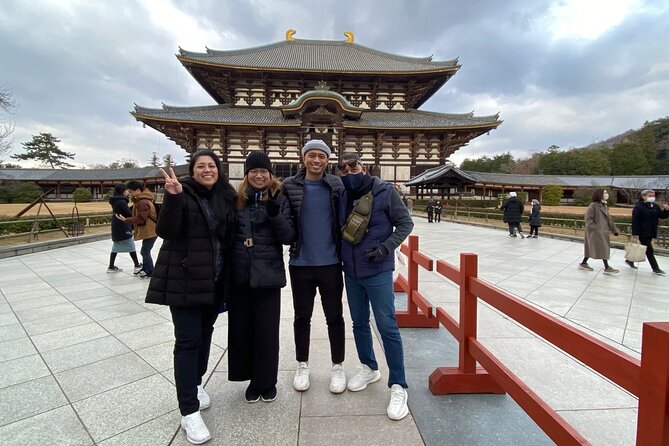
Naramachi was the former merchant district. Traditional homes, storehouses, small shops, cafes, and preserved residences line its streets. The district is useful for seeing how ordinary urban life differed from the grand temple compounds.
I would choose Naramachi if you want a break from monumental religious sites. You can look at traditional building details, browse small shops, and get a feel for Nara as a living city rather than only an ancient capital.
The Nigiwai-no-Ie traditional house is one possible stop in the area. Its tatami rooms, alcoves, and staggered shelves show the restrained design of a traditional home. Naramachi admission is listed as free, though individual attractions or purchases may have their own costs.
Kōfuku-ji, museums, and the old capital
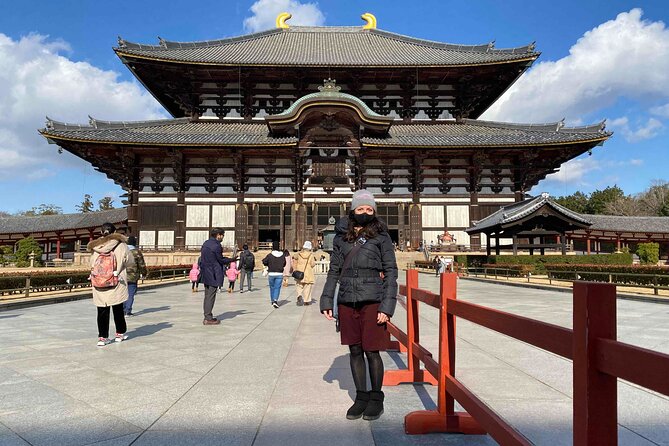
Kōfuku-ji was the family temple of the Fujiwara clan, one of the most powerful aristocratic families of the Nara and Heian periods. Its five-story pagoda and historic halls make it an important stop for anyone interested in temple architecture and political power.
The Nara National Museum, founded in 1889, focuses mainly on Japanese Buddhist art. It is a smart choice on a rainy day or for anyone who wants more than exterior views. Allowing only 30 minutes means you should be selective inside, since a museum can easily absorb several hours.
The Heijō Palace Site Historical Park marks the center of ancient Heijō-kyō, the capital during most of the Nara Period. The palace area once covered roughly one kilometer by one kilometer. It is a spacious historical site, but its scale means it may feel less immediately dramatic than Tōdaiji or Kasuga Taisha.
Gardens and quieter temple corners
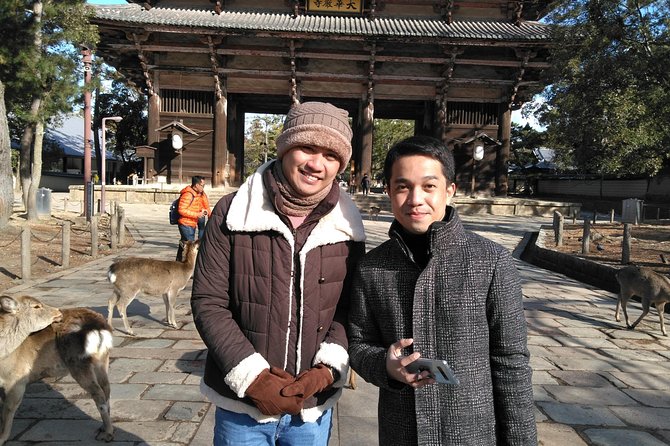
Isuien Garden is one of the best choices for a slower, more visual part of the day. It uses borrowed scenery, including Tōdaiji’s Nandaimon Gate and Mount Wakakusayama. That design lets distant buildings and hills become part of the garden composition.
Yoshikien is another pleasant garden beside the Yoshikigawa River. Its name comes from that small river, and it was built on the former site of Kōfuku-ji’s priests’ residences. These gardens are worthwhile if you want a calm pause between temples and deer.
Wakakusayama Hill offers broad views over Nara. The grass-covered mountain rises behind Nara Park and sits between Tōdaiji and Kasuga Taisha. It is about 350 meters high, and reaching the best viewpoints requires more physical effort than a quick park stroll. Admission is not included.
Tōshōdaiji, founded in 759 by the Chinese priest Ganjin, is another strong choice for Buddhist history and temple design. Ganjin came to Japan to train priests and improve Japanese Buddhism. Like Horyu-ji and Yakushiji, it is better suited to a carefully planned history-focused day than to a rushed checklist.
How much walking and planning to expect
The tour lasts about eight hours, and the published stop times are roughly 30 minutes each. Since you choose only three or four sites, that schedule should be understood as a planning guide rather than a promise that you will see everything in half an hour.
Your guide can help you avoid wasted time. Several guides have helped visitors navigate trains, find lunch, adjust routes, and fit in extra local stops. Taku, for example, has combined historic sights with sake tasting, cafes, shaved ice, and downtown Nara. That kind of flexibility is one of the main reasons to choose a private tour.
Still, Nara is a walking city for this experience. Heat, rain, crowds, and tired feet can change the pace. Tell the agency or guide about your interests and limitations in advance. Communication before the day is especially important because the guide is assigned after booking, and you cannot assume a particular guide will be available.
Guides, language, and the private format
The experience includes a government-licensed local English-speaking guide, and multilingual guides are available. Individual styles vary. Junichi is a Nara local with a strong interest in religion and history. Taku is often praised for easy-to-understand English, local stories, maps, flowers, food, and a friendly sense of humor. Yuka is noted for adapting routes and explaining architecture, while Ken is especially strong at organizing a tight day.
Masaaki suits visitors who want detailed discussion of history and architecture. Haru has been praised for careful preparation and clear explanations, and guides such as Rie, Naomi, Hiro, Momoyo, and Kazuo have helped families, couples, and people with food preferences.
The important point is that you book the service, not a guaranteed individual guide. A guide is designated after booking. One low-rated experience raised concerns about spoken English, so if clear, nuanced English is essential for your group, contact the provider with specific questions before confirming.
Because the tour is private, only your group participates. That gives you more control than a shared excursion, and you cannot combine multiple tour groups. Group discounts are offered, so the per-person price may make more sense for a larger private party than for a solo visitor.
Is $201.51 per person good value?
At $201.51 per person, this is not the cheapest way to reach Nara. You still pay for trains or other transportation, entrance fees, lunch, and personal expenses. No private vehicle is included.
The price begins to make sense if you care about interpretation, want a custom route, or have only one day for Nara. A good guide can save time finding temple entrances, choosing a sensible order, navigating public transportation, and explaining what you are seeing. The strongest benefit is the ability to replace a generic sightseeing day with one built around your group.
For two people, the cost is a serious splurge. For four or more, group pricing may improve the calculation. Independent visitors who are happy with maps and audio guides can see central Nara for less. Families, older people who want help with routing, and history-focused visitors may find the added support worthwhile.
Who should book this Nara day?
I would choose this tour if you want Tōdaiji and the deer but also want to understand why Nara matters. It is particularly suitable for families, private groups, first-time visitors, and anyone who wants help combining central sights with Horyu-ji, Yakushiji, gardens, or the old palace site.
It is also a good fit if you want a local food suggestion, help with train travel, or a guide who can adjust the day as your energy changes. Tell the guide what matters most before setting out.
I would skip it if you prefer independent wandering, dislike walking, or want transportation and admissions bundled into one price. You may also be happier with a fixed group tour if you do not care which Nara sites you visit.
FAQ
How long does the Nara private tour last?
The experience lasts approximately eight hours.
Where does the tour begin?
The stated meeting arrangement is on foot within a designated area of Kyoto. Pickup is offered, but this refers to an on-foot meetup rather than a private vehicle pickup.
Can I take the tour from Osaka?
The experience is described as a day trip from Kyoto or Osaka, and some arrangements have begun in Osaka. Confirm the exact meeting point and transport plan after booking.
How many sites can I choose?
You can choose three to four sites from the available Nara attractions.
Is transportation included?
No. Transportation fees are not included, and no private vehicle is provided.
Are entrance tickets included?
No. Admission fees are generally not included. Guide entry fees are covered only for sights listed under the experience details.
Is lunch included?
No. Lunch and other personal expenses are extra.
Is this a private tour?
Yes. Only your group participates, and multiple tour groups cannot be combined.
Is the guide licensed?
The experience includes a government-licensed local English-speaking guide. A guide is assigned after booking.
Can I cancel for a full refund?
Yes, if you cancel at least 24 hours before the experience start time. Cancellations or changes made less than 24 hours in advance are not refunded or accepted.
Should you book it?
Book this tour if Nara is important to you and you want more than a quick visit to the deer and Great Buddha. The best use of the day is to choose a clear theme: Tōdaiji, Nara Park, Kasuga Taisha, and Naramachi for a classic first visit; Horyu-ji or Yakushiji for early Buddhist art; or gardens and museums for a quieter cultural day.
The cost is high once transport and admissions are added, but the private planning and licensed guide can make one limited day count. I would ask for your preferred guide style, confirm the walking meeting point, and decide on your three or four must-see places before booking.
Just added around Kyoto
- Kyoto: Zen Meditation at a Private Temple with a Monk★ 5.0 · 25 reviews
- Kyoto: Gion Geisha District & Sake-in-Hand Walking Tour★ 5.0 · 37 reviews
- Private Pewter Sake Cup Experience with a Kyoto Artisan★ 5.0 · 31 reviews
- Your Private Vacation Photography Session In Kyoto★ 5.0 · 110 reviews
- Private Guided Traditional Buddhist Cooking in Japan★ 5.0 · 16 reviews
- Kyoto Wagashi(Japanese sweets) Cooking Class near Fushimiinari★ 5.0 · 60 reviews
- Traditional Japanese Music show & Experience Tour in Kyoto★ 5.0 · 57 reviews
- Kyoto:Family-Friendly Kimono & Yukata Experience at WARGO★ 5.0 · 147 reviews
Kyoto Tours, compared.


Fushimi Inari, Kinkakuji, Bamboo Grove 1 Day Bus Tour
Read our review →
Tea Ceremony in a Traditional Tea House in Kiyomizu
Read our review →
Kyoto Geisha Walking Tour: Gion District & Hidden Gems
Read our review →

Gion Magical Night Walking Tour with Geisha Trivia
Read our review →

Gion Geisha District Walking Tour – Stories of Geisha
Read our review →Browse the lists this tour appears in