
Reviewed · KYOTO TOURS
Kyoto Early Morning Private Tour with Government-Licensed Guide
Kyoto’s famous sights are far more pleasant before the day gets going. This private four-hour tour lets you meet a government-licensed English-speaking guide early, then choose two or three places instead of being pushed through a long fixed route.
I like the freedom to shape the morning around your interests, and I like the practical help with trains, buses, taxis, food, and local customs. Guides such as Rie, Yasu, Tomy, Mayumi, and Nabet have helped make the tour personal and useful. The main catch is simple: two or three sites in four hours means you must choose carefully, and transport and entrance fees are extra.
Key points to know before booking
- Start before the crowds: Early departures such as 6:30 or 7:00 a.m. can make Fushimi Inari and Kiyomizu-dera feel calm rather than packed.
- Pick two or three sights: You can request a route based on temples, gardens, food, old neighborhoods, or scenic areas.
- Your guide meets you on foot: Hotel pickup may be offered within the designated Kyoto area, but this is not a private-car tour.
- Public transportation is part of the experience: Guides have helped groups move around Kyoto by train, bus, and taxi, with those fares paid separately.
- The guide adds local context: Expect explanations of Japanese culture, religion, history, and everyday life, not just directions to photo spots.
- The service record is strong but not flawless: The published rating is 4.8 from 23 ratings, with a 96 percent recommendation rate, alongside one serious no-show complaint.
Why an early Kyoto start matters
The early hour is the real selling point here. Fushimi Inari-taisha, Kiyomizu-dera, the Arashiyama Bamboo Forest, and Kinkaku-ji are among Kyoto’s most visited places. Later in the day, the paths can feel crowded and the most famous views can become a contest for standing room.
An early start gives you a better chance of walking at a steady pace and hearing your guide without constant interruption. One tour began at 6:30 a.m., giving the group a smoother visit to Kiyomizu-dera and Fushimi Inari. Another began at 7:00 a.m. and finished at 11:00 a.m., with the guide then directing the group to a favorite sushi restaurant for lunch.
This timing also helps in warmer months. One guide specifically pointed out that Kyoto can get hot and busy, so starting early is a practical comfort choice, not just a photography trick.
The tradeoff is obvious. You need to be ready early, and a four-hour tour cannot cover Kyoto’s many major districts in one morning. If you want a relaxed look at several sites, choose two nearby areas rather than trying to pair Fushimi Inari with Arashiyama or northern Kyoto.
More Licensed Guide Tours in Kyoto
- Kyoto 6hr Private Tour with Government-Licensed Guide
★ 5.0 · 1,369 reviews - Kyoto 4hr Private Tour with Government-Licensed Guide
★ 5.0 · 629 reviews - Kyoto: Private Tour with Local Licensed Guide
★ 4.8 · 463 reviews
A private route built around two or three places
The tour includes a licensed local English-speaking guide and a customizable plan featuring two or three sites from a long menu of Kyoto attractions. You are not joining another group, and the guide can adjust the morning to match your interests.
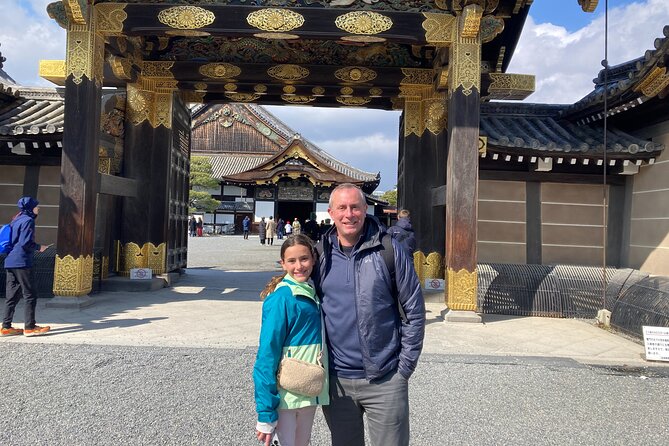
That flexibility matters in Kyoto. A first visit might call for Fushimi Inari and Kiyomizu-dera. A return visit might be better spent in Gion, Nishiki Market, and Pontocho. Families may prefer the Bamboo Forest and Monkey Park, as one group of two adults and two teenagers did, while architecture and garden fans may choose Nijo Castle and the Kyoto Imperial Palace.
You should discuss your priorities before the morning begins. The most useful choices are based on location and pace:
- Southeastern Kyoto: Fushimi Inari, Tofuku-ji, Kiyomizu-dera, and Higashiyama.
- Central Kyoto: Nijo Castle, Nishiki Market, Gion, Pontocho, and the Imperial Palace.
- Northern Kyoto: Kinkaku-ji, Ryoan-ji, and Ninna-ji.
- Western Kyoto: Arashiyama, Tenryu-ji, the Bamboo Forest, and nearby hillside temples.
- Northern mountain areas: Kibune, Kurama-dera, and Shugakuin Imperial Villa.
Some combinations work well on foot or by short public transport rides. Others sit far apart and will force you to spend too much of the four hours moving. A guide can help, but you will get more from the tour if you arrive with a short list rather than asking to see everything.
Fushimi Inari, beyond the first torii gates
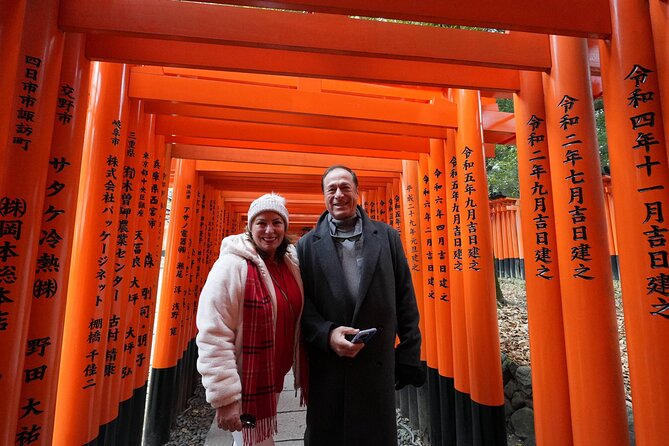
Fushimi Inari-taisha is one of Kyoto’s essential stops, known for its long passage of vermilion torii gates climbing Mount Inari. The first section is the most photographed and often the most crowded, but the shrine is more than a tunnel built for pictures.
Your guide can explain the shrine’s connection with Inari, the Shinto kami associated with rice, prosperity, and business. The fox figures around the grounds are linked with Inari and appear in many forms, sometimes holding symbolic objects.
The listed stop is free, but the mountain path can take as long as you want. On a four-hour tour, you will need to agree on how far to walk. If you want a longer climb, pair Fushimi Inari with only one nearby sight. If you want a broad Kyoto introduction, a shorter visit may make more sense.
Kiyomizu-dera and the old lanes of Higashiyama
Kiyomizu-dera is another strong early-morning choice. The temple sits on the eastern hills and is known for its large wooden stage and wide views over Kyoto. The approach through Higashiyama adds atmosphere, with preserved streets and traditional buildings leading toward the temple grounds.
The temple’s name means Pure Water Temple, referring to the Otowa Waterfall. Your guide can help explain the customs around the water and the religious meaning behind the site, details that are easy to miss if you simply follow the crowds toward the main viewpoint.
Entrance is not included in the basic tour price. The same applies to many of the temples on the route menu, so budget for tickets separately.
Higashiyama itself is free to explore, but its slopes and stone lanes require comfortable shoes. This is one of the better choices if you want old Kyoto atmosphere along with a major temple. It is less suitable if you have limited mobility, although the guide may be able to adjust the pace. The tour is described as accessible to most participants, but it remains a walking experience.
More licensed-guide days in Kyoto:
- Private Kyoto Tour with Licensed Guide & Vehicle (Max 15 persons)
★ 5.0 · 417 reviews - Nara 8hr Private Tour – Kyoto DEP. with Licensed Guide
★ 5.0 · 115 reviews - Kyoto 8hr Private Tour with Government-Licensed Guide
★ 5.0 · 51 reviews - Kyoto Arashiyama & Sagano Bamboo Private Tour with Government-Licensed Guide
★ 5.0 · 49 reviews
Gion, Nishiki Market, and Pontocho
For a more street-level morning, choose Gion and central Kyoto. Gion’s narrow lanes, traditional wooden buildings, and teahouse culture offer a look at Kyoto’s old entertainment district. A guide is useful here because the area can be confusing, and respectful behavior matters around private homes and working establishments.
Do not expect a staged geisha show simply because you are walking through Gion. The value is in understanding the district’s design, customs, and role in Kyoto life. Your guide can also help you distinguish public streets from private spaces.
Nishiki Market is a narrow, five-block shopping street known as Kyoto’s Kitchen. More than one hundred shops and restaurants sell food and kitchen goods. It is a good place to ask questions about ingredients and local eating habits, but its appeal depends heavily on opening hours and the time of day. An early start may mean some businesses are not yet fully active.
Pontocho, beside the Kamogawa River, is another atmospheric lane lined with restaurants. It is more useful for orientation and an evening dining plan than for a long morning stop, since many establishments open later. Pairing Gion with Nishiki Market makes geographic sense, and adding Pontocho works if you want a quick look rather than a full meal.
Nijo Castle and the Kyoto Imperial Palace
Nijo Castle gives you a different view of Kyoto’s past. Built in 1603 as the Kyoto residence of Tokugawa Ieyasu, the first shogun of the Edo period, it connects the city with Japan’s military government.
The castle is known for its palace rooms, gardens, and so-called nightingale floors, designed to chirp underfoot as a warning against intruders. It is a worthwhile choice if you want political history and architecture rather than a purely religious site. Admission is not included.
The Kyoto Imperial Palace served as the residence of Japan’s Imperial Family until 1868, when the emperor and capital moved to Tokyo. The palace grounds sit within a large park, giving you more open space than the tight lanes of Gion or the steep approaches around Kiyomizu-dera.
These two sites are not a natural quick pairing if you want detailed interior visits. You will need to discuss admission and walking time with the guide. For a first morning in Kyoto, Nijo Castle alone may provide a clearer experience than trying to rush both locations.
Kinkaku-ji, Ryoan-ji, and Ninna-ji
Northern Kyoto offers several major temples, but they are spread out enough that you should not try to collect all three casually.
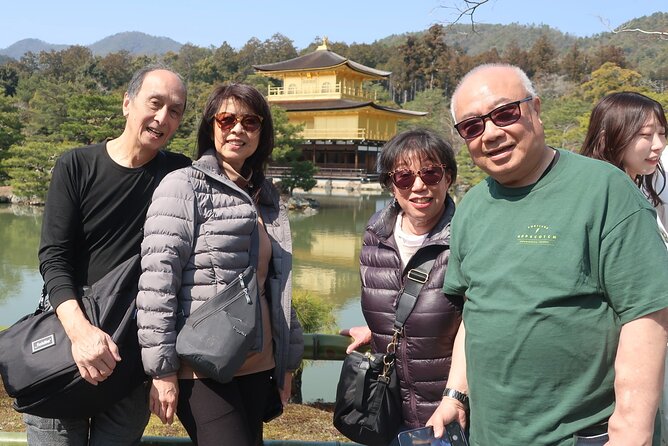
Kinkaku-ji, the Golden Pavilion, is a Zen temple whose top two floors are covered in gold leaf. The polished pavilion beside the pond is one of Kyoto’s most recognizable scenes. It is also a place where timing matters, since the main viewing area can become crowded and the route through the grounds is controlled.
Ryoan-ji is home to Japan’s best-known rock garden. Its plain stone arrangement invites quiet attention rather than a long checklist of facts. Your guide can explain Zen ideas and the design choices, but the garden still asks you to spend a few minutes looking without being hurried. Admission is extra.
Ninna-ji is a World Heritage temple and the head temple of the Omuro school of Shingon Buddhism. Its spacious grounds and religious importance make it a better choice for visitors who want something beyond the most famous photograph.
Kinkaku-ji and Ryoan-ji are a sensible pair for a focused morning. Add Ninna-ji only if your group is comfortable keeping each visit short and paying separate admission fees.
Arashiyama and the Bamboo Forest
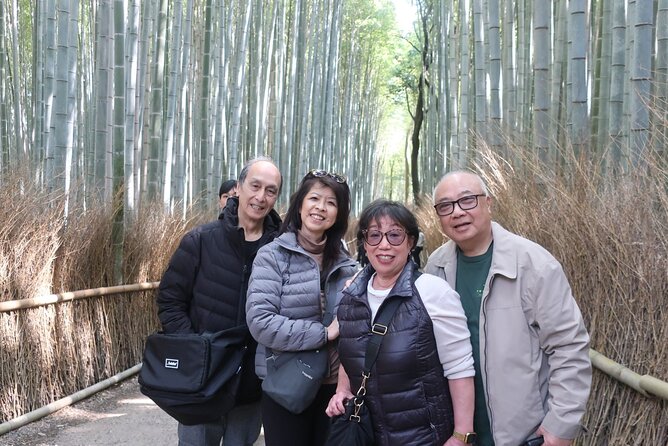
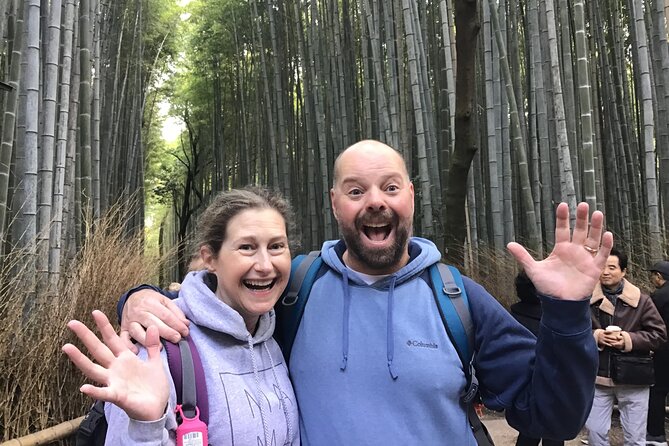
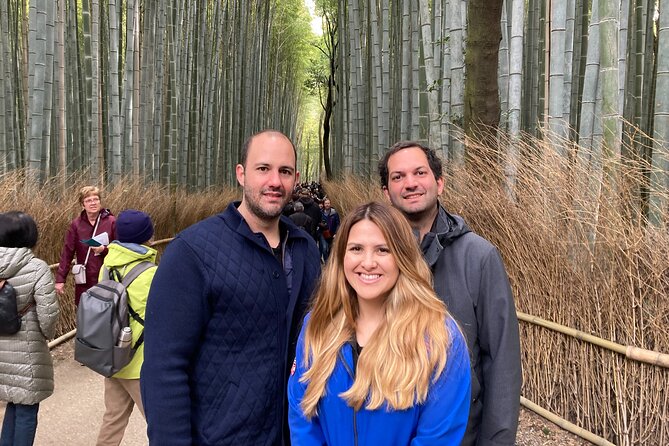
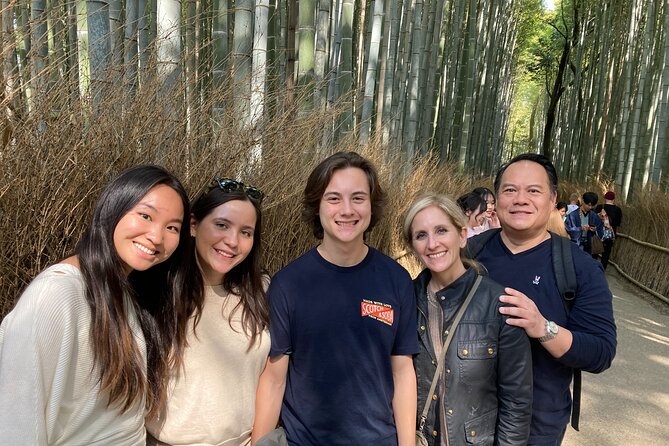
Arashiyama is one of the most requested areas on this tour. Its Bamboo Forest is photogenic, but the experience depends greatly on arriving early. The tall bamboo, narrow walking paths, and filtered light can feel peaceful before the main crowds arrive.
One group visited the Bamboo Forest, Monkey Park, and Fushimi Inari with guide Yasu. That is a memorable combination, but it also covers a lot of ground. Ask about travel time before committing to a similar plan.
Tenryu-ji is the leading temple in Arashiyama and a World Heritage site. Its garden is the reason to add it if you want a temple visit with the bamboo. Togetsukyo Bridge provides a broad river view and is free to visit.
If you have more time in western Kyoto, the nearby options become quieter and more specialized. Okochi Sanso Garden occupies the former villa of actor Okochi Denjiro and requires an admission fee. Jojakko-ji, Nisonin, and Gio-ji offer smaller temple grounds, maple trees, moss, and a more restrained mood.
Adashino Nenbutsuji is known for stone figures placed for the souls of the dead, while Otagi Nenbutsu-ji has about 1,200 distinctive stone rakan statues. These places are excellent for a repeat visit or for someone who wants a slower Arashiyama morning. They are not realistic additions to a standard four-hour first-timer route.
Tofuku-ji, Toji, and the southern temples
Tofuku-ji is a large Zen temple in southeastern Kyoto, particularly known for autumn color. It can work well with Fushimi Inari because both are in the southeastern part of the city, though you should still allow time for walking and transport.
Toji, meaning East Temple, dates from the early Heian period, soon after the capital moved to Kyoto. Its large pagoda is a familiar city landmark, and the temple offers useful context for Kyoto’s early imperial era. Admission depends on the area you visit, and the tour information lists some access as free while other temple entries are not included.
Nanzen-ji sits at the base of the Higashiyama mountains and is one of Japan’s major Zen temples. The brick aqueduct, Nanzenji Suirokaku, adds an unusual European-style structure to the temple grounds. Nanzen-ji pairs naturally with Ginkaku-ji and the Philosopher’s Path area, but those stops can fill a morning by themselves.
The northern mountains and imperial villas
The tour menu reaches beyond the central sights. Shugakuin Imperial Villa, Katsura Imperial Villa, Kibune, Kurama-dera, Yoshimine-dera, and Daikaku-ji all require more planning than a simple central Kyoto walk.
The imperial villas are valued for architecture and garden design. Shugakuin was built in the seventeenth century for Emperor Gomizuno and includes upper, middle, and lower villas. Katsura is another important example of Japanese design, with its present garden and buildings completed in the seventeenth century.
Kibune is a small forested mountain town built around Kifune Shrine. Kurama is less than an hour from central Kyoto and is known for Kurama-dera and its hot spring. These destinations offer a change from urban Kyoto, but travel time can consume much of your four-hour booking.
For these areas, ask the operator about the best meeting point and route before booking. They are better for a focused day plan than for a quick add-on to Fushimi Inari or Kiyomizu-dera.
What the guide adds to the morning
The guide’s role is more than pointing out gates and pagodas. The strongest part of this format is the chance to ask questions as they arise. Guides have discussed Japanese history, religious practice, local food, daily life, and transport, then helped people plan the rest of their Kyoto stay.
Rie contacted her group well before the trip and again during the week of the tour. She moved quickly between four locations on a busy January 2 morning and finished by directing the group to a sushi restaurant. Yasu has guided families and groups of friends using public transportation, while Tomy was praised for making a 6:30 a.m. route through Kiyomizu-dera and Fushimi Inari run smoothly.
Mayumi added about half an hour when one participant had ankle trouble. That is a good example of the value of a private guide, though you should not assume extra time is guaranteed.
Nabet’s approach focused on the calm air and quiet atmosphere of an early start, while Yoshi helped a visitor understand Japanese life and culture. The names are not a promise of a specific guide, but they show the range of people assigned to this service.
Price, transport, and what you pay separately
At $101.82 per person, the tour is not the cheapest way to see Kyoto. You are paying for a private guide rather than a seat on a large group outing, and the cost becomes easier to justify when shared by a small family or group. Group discounts may also be available.
The price includes the guide and a custom tour of two or three listed sites. It does not include a private vehicle, transportation fares, entrance tickets, lunch, or personal expenses. The guide meets you on foot within a designated Kyoto area, and hotel pickup, when offered, is also on foot.
That structure is worth understanding before you book. If you choose three temples with admission fees and use several trains or buses, the final cost will be higher. On the other hand, a good guide can save you time and prevent a morning from being lost to wrong turns or poor site choices.
The tour is best value for a first Kyoto visit, a family that needs help with pacing, or a small group with clear interests. If you are comfortable navigating trains and reading temple signs, you may get better value by visiting two nearby sites on your own.
Who should book this private morning?
Book it if you want personal attention, early access, and a useful introduction to Kyoto’s customs and layout. It suits families, first-time visitors, small groups, and anyone who wants to ask many questions without slowing down a larger party.
It also works well for visitors with only a short Kyoto stay. A guide can help you choose a sensible pair of sights and then leave you with ideas for the afternoon.
Think twice if you want a leisurely, all-day temple study, a private car, or a guarantee of one particular guide. This is a four-hour walking tour, not a full sightseeing day. It is also wise to keep expectations realistic about reliability: the service has a strong 4.8 rating from 23 ratings and a 96 percent recommendation rate, but one booking involved a guide who became ill and did not appear, followed by a delayed refund process.
Free cancellation is available up to 24 hours before the start time. Changes or cancellations inside that window are not accepted for a refund.
My verdict on the Kyoto early morning tour
I would book this tour when I wanted to make Kyoto’s busiest sights less stressful and needed help choosing among too many good options. The strongest plan is two nearby attractions, such as Fushimi Inari and Tofuku-ji, Kiyomizu-dera and Higashiyama, or Kinkaku-ji and Ryoan-ji.
I would not book it expecting to see half of Kyoto in four hours. Choose a compact route, confirm the meeting details, budget for tickets and transport, and treat the guide as a cultural interpreter and practical city helper. For the right group, that personal guidance is worth more than another rushed stop.
FAQ
How long is the Kyoto early morning private tour?
The tour lasts approximately four hours.
How many attractions can I choose?
The included plan is customizable around two or three sites from the available attraction list.
Is this a private tour?
Yes. Only your group participates, and you cannot combine multiple tour groups.
Does the tour include a private vehicle?
No. A private vehicle is not included. The experience is a walking tour, and guides may use public transportation or taxis with you.
Are transportation fares included?
No. Transportation fees are paid separately.
Are entrance fees included?
Entrance fees are not generally included. The tour information specifically lists admission as not included for places such as Nijo Castle, Kiyomizu-dera, Kyoto Imperial Palace, Kinkaku-ji, Ryoan-ji, and many other temples.
Where does the guide meet me?
The guide meets you on foot within a designated area of Kyoto. Pickup may be offered, but it is on foot rather than by private vehicle.
Is the tour conducted in English?
The tour includes a licensed local English-speaking guide. Guides named in the service information include Rie, Yasu, Tomy, Mayumi, Nabet, Yoshi, Kay, Yoji, Bell, and others.
Can I cancel for a full refund?
Yes, if you cancel at least 24 hours before the experience start time. Cancellations or changes made less than 24 hours before the start time are not eligible for a refund.
More Morning in Kyoto
- Kyoto Early Morning Tour with English-Speaking Guide
★ 5.0 · 1,427 reviews - Kyoto: Early Morning Tour with English-Speaking Guide
★ 4.9 · 1,128 reviews - From Kyoto: Nara Guided Morning Tour
★ 4.6 · 335 reviews - Kyoto Morning Tour from Kyoto or Osaka
★ 4.0 · 281 reviews
Just added around Kyoto
- Kyoto: Zen Meditation at a Private Temple with a Monk★ 5.0 · 25 reviews
- Kyoto: Gion Geisha District & Sake-in-Hand Walking Tour★ 5.0 · 37 reviews
- Private Pewter Sake Cup Experience with a Kyoto Artisan★ 5.0 · 31 reviews
- Your Private Vacation Photography Session In Kyoto★ 5.0 · 110 reviews
- Private Guided Traditional Buddhist Cooking in Japan★ 5.0 · 16 reviews
- Kyoto Wagashi(Japanese sweets) Cooking Class near Fushimiinari★ 5.0 · 60 reviews
- Traditional Japanese Music show & Experience Tour in Kyoto★ 5.0 · 57 reviews
- Kyoto:Family-Friendly Kimono & Yukata Experience at WARGO★ 5.0 · 147 reviews
Kyoto Tours, compared.


Fushimi Inari, Kinkakuji, Bamboo Grove 1 Day Bus Tour
Read our review →
Tea Ceremony in a Traditional Tea House in Kiyomizu
Read our review →
Kyoto Geisha Walking Tour: Gion District & Hidden Gems
Read our review →

Gion Magical Night Walking Tour with Geisha Trivia
Read our review →

Gion Geisha District Walking Tour – Stories of Geisha
Read our review →Browse the lists this tour appears in