
Reviewed · HIROSHIMA TOURS
Walking Through History: Hiroshima’s Path to Peace
Hiroshima’s Peace Park can feel like a quiet collection of monuments until someone explains how the pieces fit together. This two-hour walk links the Atomic Bomb Dome, children’s memorials, survivor stories, and international calls for peace into one clear route, led by a PhD scholar.
I like the small maximum of eight people, which makes it easier to ask questions and easier for the guide to adjust the pace. I also like the prepaid Peace Memorial Museum ticket, since you can skip the long entrance line and spend your energy on the exhibits.
The main consideration is that this is a serious, emotionally heavy experience, not a casual sightseeing stroll. The museum portion is self-guided because tour guides cannot speak inside, and the walk can feel long on a hot day, so bring comfortable shoes and water.
Key points to know before you book
- Nine meaningful stops: The route moves from the Atomic Bomb Dome through the Peace Park to the Gates of Peace.
- A small group format: The tour accepts no more than eight people, allowing time for questions and personal pacing.
- PhD-level historical guidance: Guides including Ghani, Sheraz, Shiraz, Cva, and Sharain have led sessions with detailed explanations and personal stories.
- Museum admission included: Your Peace Memorial Museum ticket is bought ahead of time, helping you avoid the main line.
- Mostly flat walking: The route is described as an easy walk, though you will cover plenty of ground.
- Flexible cancellation: You can receive a full refund if you cancel at least 24 hours before the start time.
Why this Hiroshima walk works so well
Hiroshima’s Peace Memorial Park is not difficult to reach or navigate, but it is easy to miss the meaning behind its monuments. A guide gives each stop a place in the larger story, from the physical remains of the Atomic Bomb Dome to the names and personal accounts held in the memorial buildings.
The route is also well suited to a short stay. It lasts about two hours, begins at 1-chōme-10-1 Ōtemachi, and ends at the Gates of Peace in Nakajimachō. If you are coming from Kyoto for the day, this concentrated visit can help you make good use of your limited time.
The strongest part of the experience is the human scale. The route does not deal only in dates and military facts. It includes children, Korean victims and survivors, individual families, and people whose lives were changed by the bombing. Guides such as Ghani and Sheraz are described as patient, sociable, and willing to answer questions rather than simply recite a script.
You should also expect the guide to invite participation. One guide uses questions and asks the group to think through possible answers, which gives the walk more energy without turning it into a classroom lecture.
More history-led days in Hiroshima:
- Hiroshima Historical Walking Tour – Why A-Bomb was Dropped
★ 4.8 · 893 reviews - Hiroshima Peace (Heiwa) Walking Tour at World Heritage Sites
★ 5.0 · 872 reviews - Miyajima Half-day Trip Historical Walking Tour
★ 5.0 · 284 reviews
The Atomic Bomb Dome begins the story
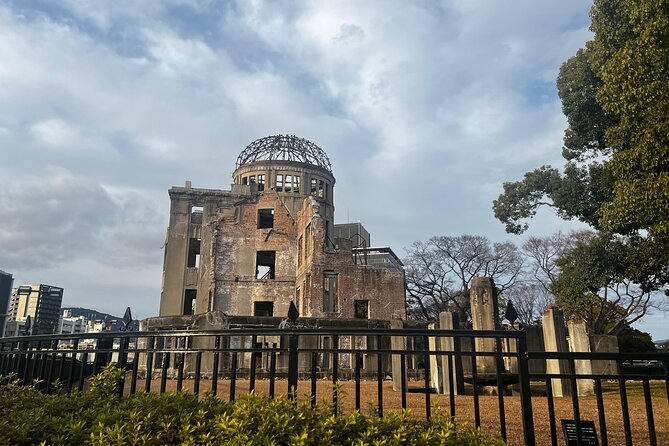
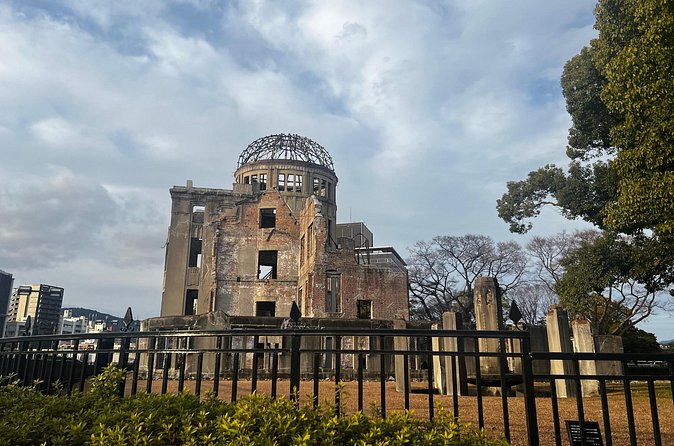
The Atomic Bomb Dome is the first major stop and receives about 20 minutes. Its damaged structure is difficult to look at casually. The surviving framework and walls offer a direct connection to the destruction of August 1945, while the building’s location beside the river makes the setting feel open and exposed.
Your guide uses this point to explain the bombing and the Dome’s later place in Hiroshima’s peace movement. You will hear why the site became a UNESCO World Heritage Site and how it came to represent both catastrophe and the city’s call for peace.
This is a good first stop because it gives you something physical to focus on before the route moves toward more symbolic monuments. Give yourself time to look closely rather than treating it as a quick photo stop.
The Peace Bell and a call without borders
The Peace Bell takes about 10 minutes. Its message is simple: harmony and a world without nuclear weapons. The deep sound of the bell is meant to encourage reflection on unity, and your guide can explain why it belongs in the park’s chain of memorials.
This stop is less about a long explanation and more about the mood of the place. You may find it useful to pause here and let the setting settle before moving on. The walk generally allows enough time at each location for photographs and questions, though your exact pace will depend on the group.
Remembering Korean victims and survivors
The Monument to Korean Victims and Survivors is an important part of the route because it widens the story beyond Hiroshima’s Japanese population. The monument honors Koreans who died or survived the bombing and recognizes their place in the city’s history.
This is one of the tour’s more valuable stops. Hiroshima’s memorial spaces can be misunderstood if they are presented only through a national Japanese lens. A guide who includes Korean victims, suffering, and reconciliation gives you a fuller picture of who was affected.
At the same time, the historical discussion should include the wider wartime context. One point worth keeping in mind is that Japan was a wartime aggressor seeking regional and global expansion alongside Germany. The bombing and its victims deserve remembrance, but a responsible account also recognizes the conflict that led to the Pacific War. If this balance matters to you, ask your guide directly about it.
More walking tours in Hiroshima:
- Hiroshima City 4hr Private Walking Tour with Licensed Guide
★ 5.0 · 437 reviews - Hiroshima Walking Tour Why A Bomb was dropped to Hiroshima
★ 5.0 · 347 reviews - Hiroshima: History of Hiroshima Group Walking Tour
★ 4.8 · 266 reviews - Hiroshima: Food and Culture Guided Walking Tour with Dinner
★ 4.9 · 212 reviews
The Children’s Peace Monument and Sadako’s cranes
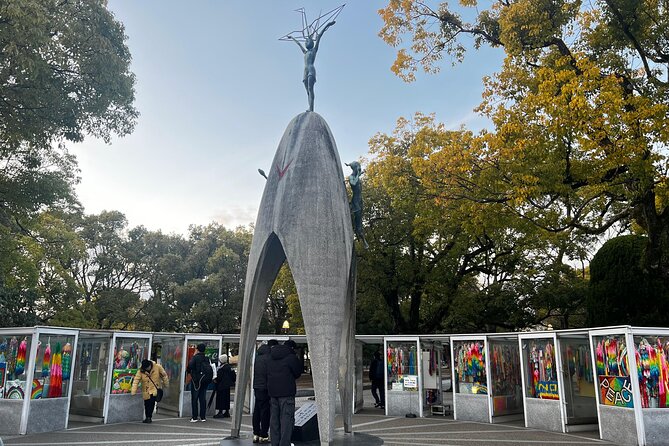
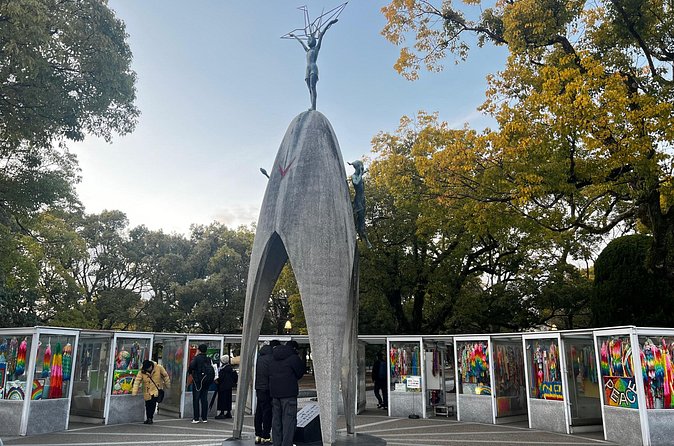
The Children’s Peace Monument takes around 10 minutes and is inspired by Sadako Sasaki, a young girl who folded paper cranes while hoping to survive. The monument remembers children who died because of the bombing and has become one of the park’s most recognizable places.
The paper cranes surrounding the statue give this stop a strong visual and emotional focus. They connect a huge historical event to the experience of one child, which is often easier to understand than a list of numbers.
Your guide may provide the background that makes the monument more than a picture stop. This is also a place where you may want a little quiet. The tour is informative, but it does not require every moment to be filled with speech.
The Peace Flame and the cenotaph
The Peace Flame has burned continuously since 1964. It represents Hiroshima’s commitment to a world without nuclear weapons and is intended to remain lit until nuclear arms have been abolished.
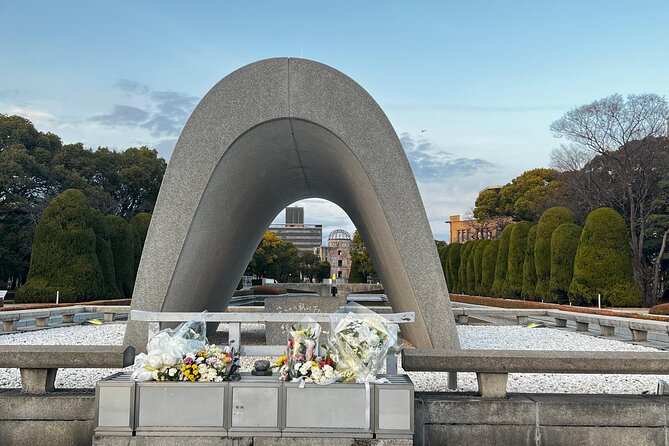
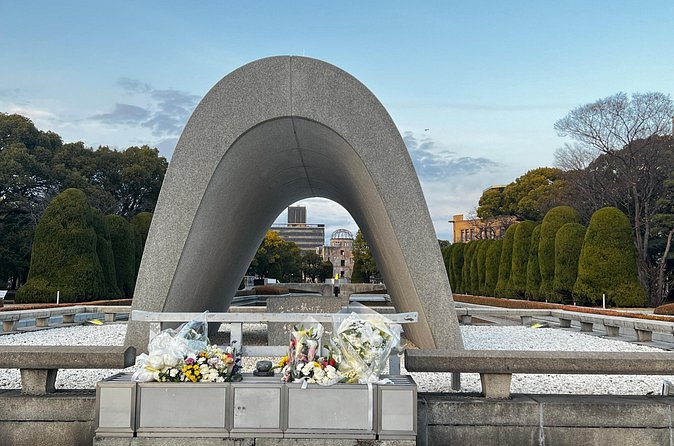
From there, the route reaches the Hiroshima Peace City Monument, also called the Cenotaph for the Atomic Bomb Victims. Its arched design shelters the names of known victims, and the monument is aligned with the Peace Flame and the Atomic Bomb Dome.
The cenotaph carries the inscription promising that the souls resting there will be remembered and that the evil will not be repeated. Your guide can explain how the layout of the park creates a line between these major sites. That connection matters: you are not simply moving from one monument to another, but following a planned sequence of memory, mourning, and hope.
Allow yourself time to take in the names and the shape of the monument. Ten minutes may pass quickly here, especially if your group wants photographs or questions.
A quiet pause at the National Peace Memorial Hall
The Hiroshima National Peace Memorial Hall for the Atomic Bomb Victims offers a quieter setting than the open-air monuments. You will encounter personal stories, photographs, and survivor testimonies, with a design intended to encourage contemplation.
The listed time is about 20 minutes, making this one of the longer indoor stops. It is a useful change of pace after walking through the park, and the personal material can make the history feel less distant.
This is also where the small-group format helps. A good guide knows when to explain and when to give people room to process what they have seen. Guides have been praised for stopping in the shade, slowing down in oppressive heat, and allowing time for photographs. That same patience is especially helpful around the memorial hall.
The Peace Memorial Museum is your independent visit
The tour includes an entrance ticket to the Hiroshima Peace Memorial Museum, purchased in advance. That is a practical benefit because you can skip the long entry line and get inside without arranging admission separately.
There is an important limit: your guide cannot speak inside the museum. You will visit on your own, so treat this part as a self-guided extension rather than a guided museum tour. The itinerary assigns about 10 minutes to this stop, but the museum portion works best when you understand that the walking tour and indoor visit are not the same experience.
If you want time with the displays, personal accounts, and photographs, check the schedule and allow yourself enough room beyond the formal walking portion. The guide can explain the setting and prepare you for the museum, but the exhibits themselves are yours to consider independently.
This arrangement suits people who prefer to hear context first and then move through sensitive material at their own pace. It may disappoint you if you expect the guide to accompany you through every gallery.
Ending at the Gates of Peace
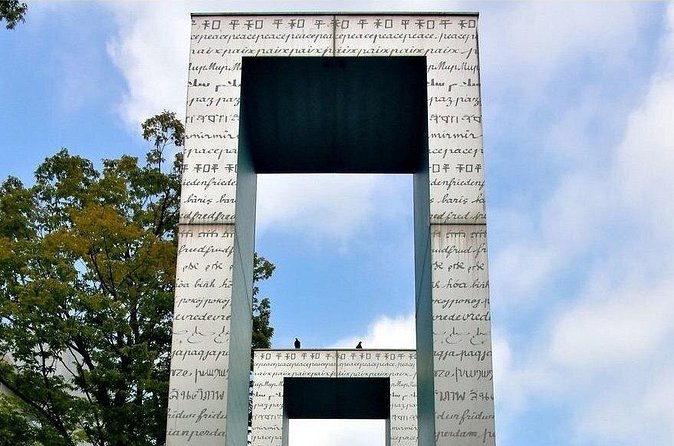
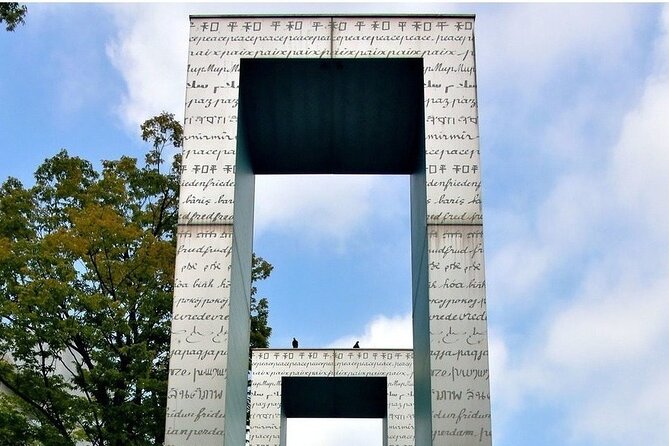
The final stop is the Gates of Peace, a series of ten glass gates inscribed with the word peace in different languages. The design carries Hiroshima’s message beyond Japan, suggesting that nuclear disarmament and reconciliation concern the whole world.
The tour ends at 4-15 Nakajimachō, rather than returning you to the starting point. That is useful if you are continuing elsewhere in Hiroshima, but plan your next move from the end location instead of assuming you will finish where you began.
Ending here gives the experience a forward-looking note. The earlier stops deal with destruction, remembrance, and grief. The glass gates shift your attention toward a shared hope for peace.
The guides and the small-group feel
The guide is central to the value of this experience. The tour is led by a PhD scholar, and named guides connected with the experience include Ghani, Sheraz, Shiraz, Cva, and Sharain. The strongest qualities to expect are careful explanations, patience, enthusiasm, and a willingness to answer questions.
Ghani is described as an unbiased historian who adds local anecdotes and adjusts the pace to the physical needs of the group. Sheraz is praised for making the walk interactive and for bringing substantial historical detail without losing a friendly manner. Sharain is described as pleasant, prepared, and enthusiastic.
Your guide may not be the same person on every departure, so the style can vary. Still, the format gives you a better chance of speaking directly with the guide than a large coach tour would. The group limit of eight is especially useful if you have questions about the bombing, memorial design, Korean victims, or Japan’s wartime role.
Walking conditions, timing, and practical comfort
The walk is described as flat and manageable for most people. It is still a full route through the Peace Park, with several stops and enough distance between them to require comfortable shoes. One guide slowed down for a person with a recent knee injury, and the tour can accommodate a group’s pace when needed.
Service animals are allowed, and the meeting point is near public transportation. Confirmation arrives when you book. Most people can take part, but the heat deserves attention, especially in summer. One session took place on an oppressively hot day, and the guide made a point of stopping in the shade.
The experience is offered with mobile ticketing, so keep the booking information accessible on your phone. Since the tour ends at a different point, check the start and finish locations before setting out.
Is $31.63 a fair price?
At $31.63 per person, this is a reasonable price if you want context rather than simply a route map. All listed outdoor stops are free, so the fee mainly pays for the guide’s time, the small group, the historical interpretation, and the included museum admission.
The value improves if you are visiting Hiroshima for only one day. You can see the key Peace Park monuments in an organized order, ask questions as you go, and avoid arranging the museum ticket yourself. A self-guided visit costs less in guiding fees, but you would need to connect the sites and research their meanings on your own.
The price is less compelling if you already plan to spend several hours at the museum and have researched the park carefully. It is also not the best choice if you want a private tour, since the group can include up to eight people.
Who should book this experience?
I would recommend it to first-time visitors who want a clear introduction to Hiroshima’s memorial sites. It is also a strong fit for history-minded visitors, people on a day trip from Kyoto, and anyone who prefers to ask questions rather than read every detail from a guidebook.
Families may appreciate the Children’s Peace Monument and the manageable two-hour length, though the subject matter is difficult. The route also suits people who need a considerate pace, provided they are comfortable with walking outdoors and spending time at emotionally serious sites.
You should think twice if you want a relaxed city walk with light commentary. Hiroshima’s Peace Park is quiet, but this is not light entertainment. The material includes death, survivor testimony, wartime suffering, and nuclear weapons.
Should you book the Hiroshima Peace Walk?
Book this tour if you want the Peace Park to make sense as a connected place rather than a series of isolated monuments. The small group, included museum ticket, flat route, and strong guide-led explanations make $31.63 good value for a first visit.
Choose it with realistic expectations. The museum is self-guided, the subject is heavy, and the route ends away from its starting point. Wear comfortable shoes, protect yourself from heat, and ask about Japan’s wartime aggression as well as the suffering caused by the bombing.
For a compact introduction to Hiroshima’s path from destruction toward peace, this is a thoughtful choice.
FAQ
How long does the Hiroshima walking tour last?
The tour lasts approximately two hours.
What is the price of the tour?
The listed price is $31.63 per person.
How many people can join the tour?
The group has a maximum of eight participants.
Is the Peace Memorial Museum ticket included?
Yes. The entrance ticket is purchased in advance and included with the experience.
Can the guide accompany me inside the Peace Memorial Museum?
No. Guides are not allowed to speak inside the museum, so you visit that part independently.
Where does the tour begin?
The meeting point is 1-chōme-10-1 Ōtemachi, Naka Ward, Hiroshima, 730-0051, Japan.
Where does the tour end?
The tour ends at the Gates of Peace, 4-15 Nakajimachō, Naka Ward, Hiroshima, 730-0811, Japan.
Is the walking route difficult?
The route is described as an easy, mostly flat walk, though you should wear comfortable shoes because there is plenty of walking.
Are service animals allowed?
Yes, service animals are allowed.
Can I cancel for a full refund?
Yes, if you cancel at least 24 hours before the experience start time. Cancellations made less than 24 hours in advance are not refunded.
Just added around Hiroshima
- The Peace Memorial to Miyajima : Icons of Peace and Beauty★ 4.5 · 31 reviews
- Shore Excursion from Hiroshima Port : Private Tour in Hiroshima★ 5.0 · 17 reviews
- Hiroshima Saijo Sake Tasting Tour with visit to 7 Breweries★ 5.0 · 104 reviews
- Hiroshima & Miyajima All-Inclusive Tour w/Licensed guide Pancho★ 5.0 · 54 reviews
- Hiroshima Country Cycling: Explore Rural Life 1 HR from City★ 5.0 · 22 reviews
- Okunoshima Rabbit Island Cycling Tour with Local Guide★ 4.5 · 17 reviews
- Private Full Day Hiroshima Tour★ 4.5 · 29 reviews
- Hiroshima Private Tour with a Local – Highlights & Hidden Gems★ 4.5 · 24 reviews
Hiroshima Tours, compared.

Peaceful Hiroshima & Miyajima UNESCO 1 Day Bus Tour
Read our review →
Hiroshima and Miyajima UNESCO Sites 1-Day Tour
Read our review →
Hiroshima Historical Walking Tour – Why A-Bomb was Dropped
Read our review →
Hiroshima Peace (Heiwa) Walking Tour at World Heritage Sites
Read our review →
Hiroshima in a Nutshell: Morning Bike Adventure
Read our review →
Hiroshima City 4hr Private Walking Tour with Licensed Guide
Read our review →

Japanesel Archery Experience HIROSHIMA CASTLE SHARAKU
Read our review →Browse the lists this tour appears in