
Reviewed · KYOTO TOURS
Kyoto: Gion Geisha District Walking Tour and Hidden Gems
Kyoto’s best stories often unfold in the spaces between its famous sights. This three-hour walk from Gion to Kiyomizu-dera links lantern-lit lanes, wooden townhouses, shrines, parks, and temple approaches while your guide explains how geisha, maiko, religion, and ordinary city life fit together. I like the route’s broad sweep, and I like that the guides, including Ben, J, and Jay, bring history down to a human scale with anecdotes and time for questions.
The tour covers a lot for $25, and the route ends at Kiyomizu-dera rather than where it begins, which makes the finish feel useful for a day of sightseeing. The tradeoff is simple: there are many steps and three hours on foot, so this is not a good match for a low fitness level or anyone hoping for a slow, mostly flat stroll.
Key points
- Gion to Kiyomizu-dera in one walk: The route connects several major sights across Gion and northern Higashiyama.
- Geisha culture explained in context: Learn about maiko and geisha training, work, and daily life rather than simply looking at old teahouses.
- Strong history focus: Guides such as J, who has a history degree, and Ben are prepared to discuss Kyoto, samurai, the Shinkansen, tanuki, and modern Japan.
- Quiet lanes and small religious sites: The walk includes backstreets and shrines that can be easy to pass without a guide.
- Good for mixed-age families: The storytelling has worked for children aged 11 and 15 as well as a 79-year-old, though the steps still matter.
- Flexible booking: You can cancel up to 24 hours ahead for a full refund and reserve without paying immediately.
Starting beside Ben’s Cookies on Shijo

The meeting point is in front of Ben’s Cookies Kyoto Shijo. Your guide holds a sign, so the first task is finding the right person in a busy commercial part of Kyoto.
The opening 10 minutes at Ben’s Cookies is short, but useful. It gives the guide time to gather the group and set the tone before the walk leaves the main shopping streets. You are not beginning at a grand monument. That is part of the appeal. The tour starts in present-day Kyoto, then gradually moves into older streets and religious precincts.
Look for a guide holding the sign rather than waiting for a formal ticket booth or tour desk. Since the experience is in English, it suits visitors who want explanations as they walk, not a self-guided route with facts delivered through an app.
More Hidden Gems Walks in Kyoto
- Kyoto Geisha Walking Tour: Gion District & Hidden Gems
★ 4.7 · 3,273 reviews - Private Kyoto Tour with a Local, Highlights & Hidden Gems, Personalised
★ 5.0 · 1,543 reviews - Arashiyama Bamboo Forest & Hidden Gems Bike Tour (Early Bird)
★ 5.0 · 613 reviews
Gion Tatsumi Bridge and the world of geisha
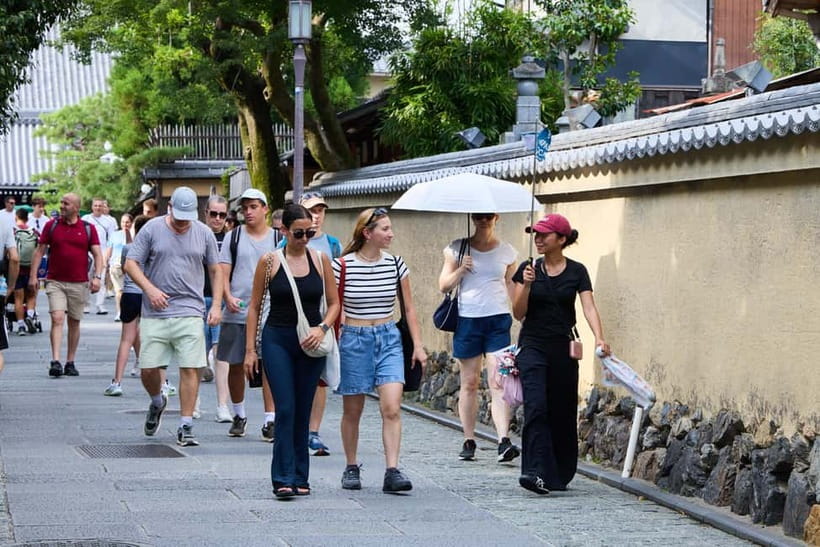
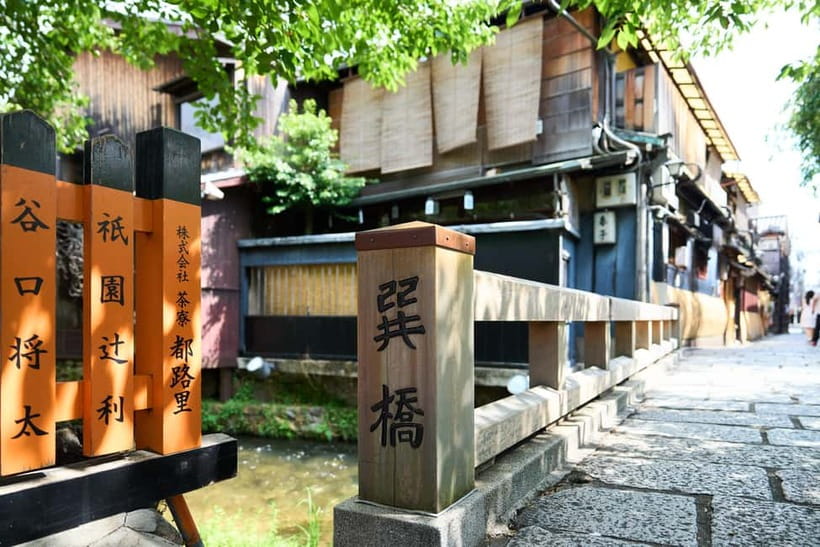
Gion Tatsumi Bridge is one of the first major stops, with about 20 minutes for a guided visit. This is where the tour’s focus on geisha culture becomes concrete.
Gion is known for traditional teahouses, preserved wooden townhouses, narrow lanes, and lanterns. A guide can explain what you are seeing and, just as important, what you are not seeing. Maiko and geisha are working professionals, not costumed characters placed in the district for photographs. The useful part of this stop is learning about training, etiquette, and the difference between public images of geisha culture and daily working life.
The guides also connect Gion to Kyoto’s larger story. The city was once Japan’s imperial capital, yet it remains a living place where residents work, shop, and commute. That contrast gives the old buildings more meaning. You are not just admiring a pretty street. You are seeing how an old district continues to function.
A sighting of a maiko or geisha should not be treated as the purpose of the walk. The activity promises cultural explanation, not a guaranteed encounter. I would book this section for the context, the architecture, and the chance to ask questions.
Chion-in, where the walking becomes more serious
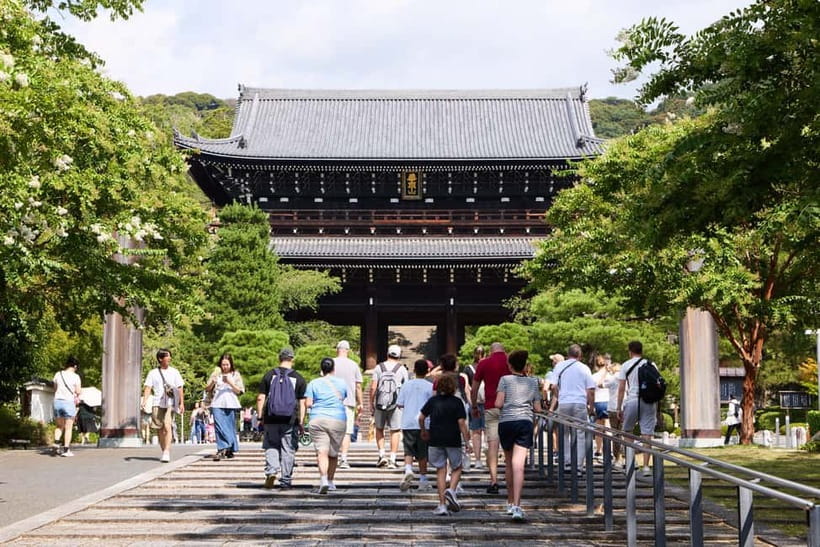
The stop at Chion-in lasts about 30 minutes, making it one of the most substantial visits on the route. It also signals the physical shape of the day. This is not a flat neighborhood ramble. You should expect stairs and uphill sections.
Chion-in gives the guide room to discuss Kyoto’s religious traditions and the way Buddhism shaped the city. The tour information does not specify an inside visit or admission arrangement, so you should think of this as a guided stop at the site rather than assume that every building or interior is included.
The longer pause matters. A three-hour route covering Gion and northern Higashiyama could easily become a march from one photo stop to the next. At Chion-in, the guide can explain what the temple represents, answer questions, and let you take in the setting before moving on.
One guide identified as J has a degree in history, and that background is especially useful at places such as Chion-in. Kyoto’s past is long and complex, and the best explanations connect religious practice with political and social change. The strongest part of this tour is not a single fact. It is the steady linking of places to the wider story of Japan.
Maruyama Park and a needed pause
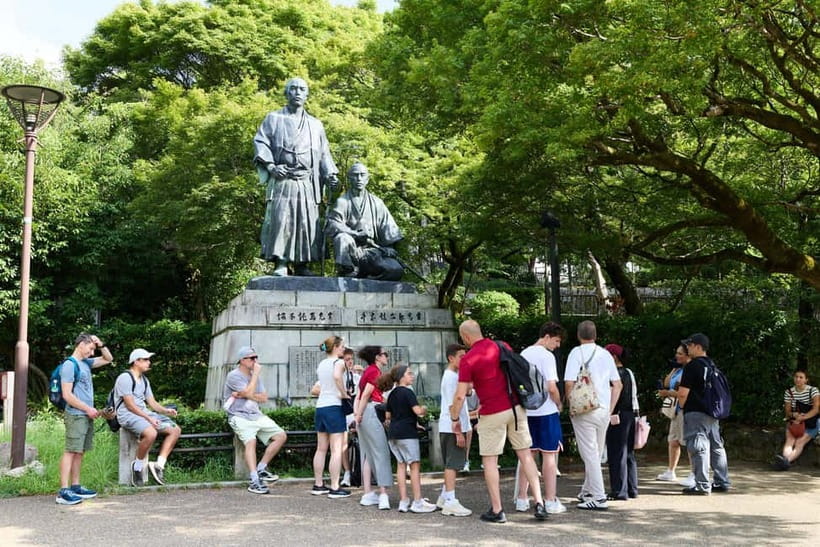
Maruyama Park receives about 20 minutes. After the steps around Chion-in, this stop helps break up the route.
The park provides a change from temple grounds and narrow streets. Your guide can continue the discussion of Kyoto’s past and present while you have some breathing room. One particularly practical point from the tour’s feedback is that Ben allowed time to rest when possible during the long walk. That makes a difference, especially in warm weather or for groups with mixed fitness levels.
A family with children aged 11 and 15 and a 79-year-old found the explanations easy to follow and engaging. That does not remove the physical challenge, but it suggests the pace and subject matter can work across generations when the group takes sensible pauses.
Bring water. It is the one item specifically recommended, and you will be glad to have it. Comfortable walking shoes are also sensible, though the supplied details only formally require water.
More off-the-list walks in Kyoto:
- Kyoto: Hidden Gems E-Bike Tour with Local Japanese Guide
★ 4.9 · 189 reviews - Kyoto: Gion Hidden Gems & Geisha Culture Tour
★ 4.9 · 126 reviews - Highlights & Hidden Gems With Locals: Best of Kyoto Private Tour
★ 5.0 · 121 reviews - Kyoto: Hidden Gems E-Bike Tour Through Backstreets & Temples
★ 4.9 · 54 reviews
Hōkan-ji and the famous pagoda view
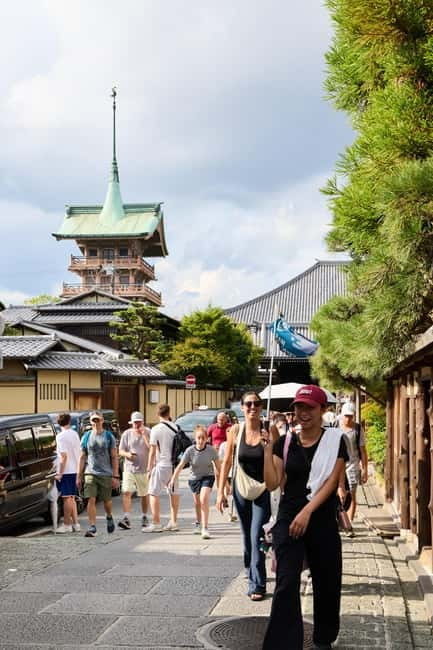
The Hōkan-ji stop lasts about 10 minutes. The temple is associated with the familiar five-story pagoda rising above Higashiyama’s old streets, and this part of the route offers one of the walk’s clearest photo opportunities.
Ten minutes is enough for an explanation and a quick look, but not enough for a long temple visit. That is worth knowing if you prefer a quiet, extended stay at each site. This tour is built around connections and movement. It gives you a guided introduction to several places rather than a deep visit to one temple.
The old wooden buildings around this area help explain why Higashiyama remains one of Kyoto’s most recognizable districts. At the same time, these streets can feel more crowded than the quieter lanes earlier in the walk. Your guide’s local perspective is most useful here, helping you notice details beyond the standard pagoda photograph.
Ninenzaka and Sannenzaka, two short but busy lanes
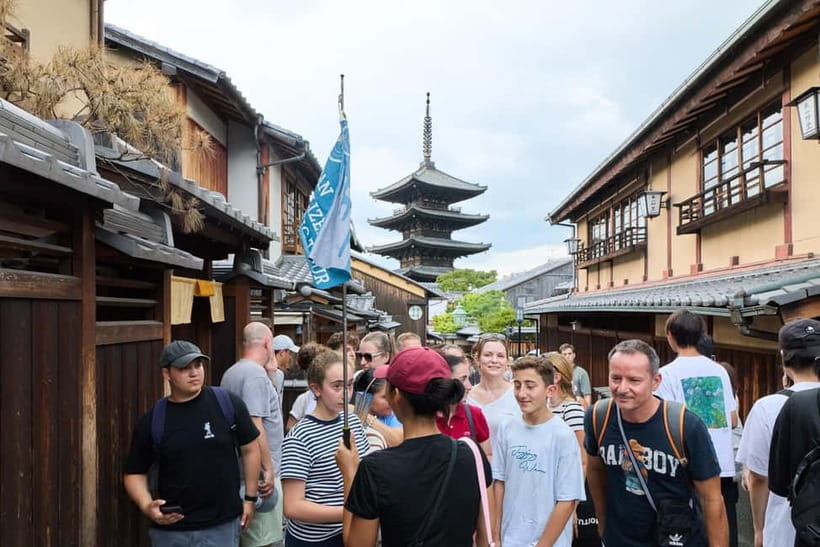
Ninen Zaka Path and Sannenzaka each receive about five minutes of guided attention. These are short stops, but they are important links in the route to Kiyomizu-dera.
The streets are known for traditional façades, shops, slopes, and preserved visual character. Five minutes does not allow much time for browsing, shopping, or stopping in every doorway. Instead, the guide helps you understand why the lanes look the way they do and points out the route toward the final gate.
This is another place where you should manage expectations. If you want a leisurely shopping session, you will need to return later on your own. If you want an introduction to the district with historical explanation, the brief stop works well.
The route’s many changes of scene are a strength. You move from Gion’s teahouse district to temple grounds, a park, a pagoda view, and sloping lanes. The drawback is that the schedule leaves limited time for lingering. Keep your camera ready, but do not expect every stop to feel unhurried.
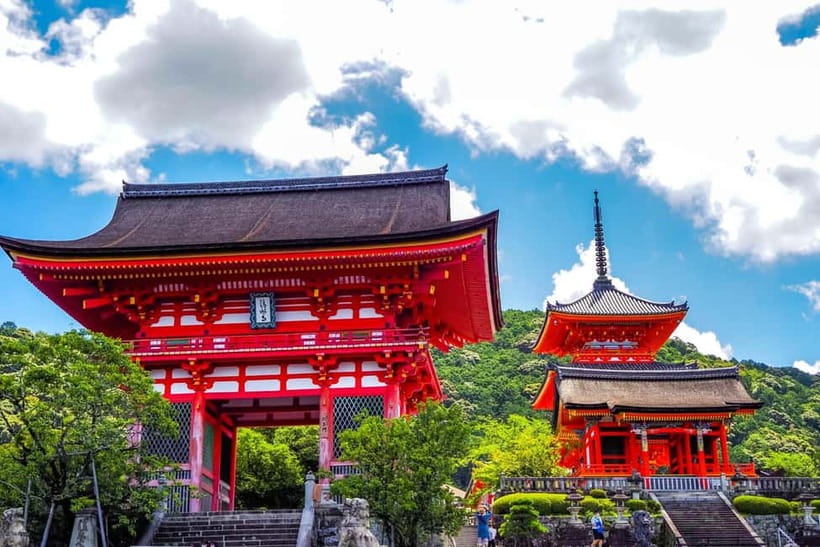
Finishing at Kiyomizu-dera Niomon Gate
The walk ends at Kiyomizu-dera Niomon Gate, not back at the Shijo meeting point. I consider that a practical design. You finish in one of Kyoto’s main sightseeing areas, with the option of continuing around Kiyomizu-dera or exploring Higashiyama afterward.
The final approach is also a satisfying close to the route. You have moved from modern Shijo into Gion, across religious sites and parkland, and through the old streets of Higashiyama. The changing surroundings make the route feel like a small cross-section of Kyoto.
The tour details do not state that entry to Kiyomizu-dera is included. Treat the gate as the endpoint of the guided walk, and check separately if you want to enter additional areas. This distinction is useful because the $25 price is for the guided tour, not an all-inclusive temple ticket package.
What the guides add to the walk
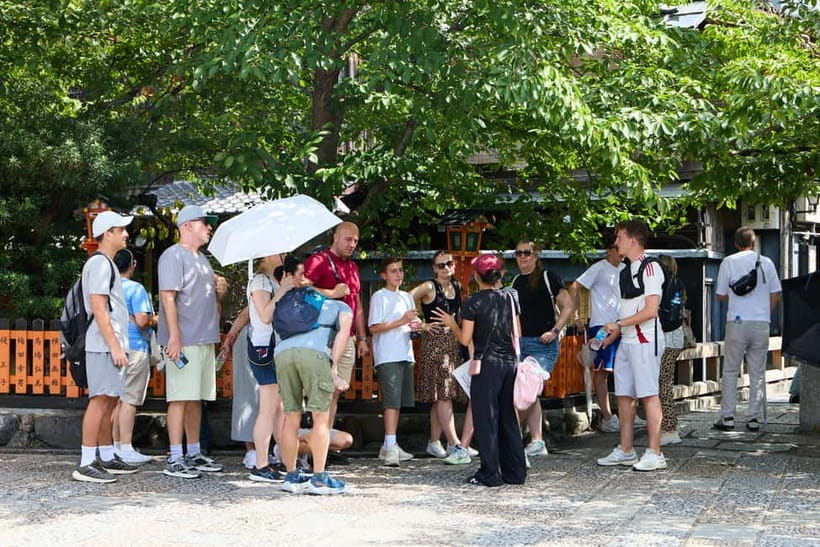
The guide is the main reason to choose this experience instead of following the same streets alone. Ben is praised for explaining Kyoto’s history extensively and for accommodating the group. J is described as lively, patient, and able to handle detailed questions, with formal history training. Jay is also identified as a friendly guide who explains the city’s past in an approachable way.
The guide’s range appears to go beyond the named stops. Subjects brought into the walk have included samurai, the Shinkansen, tanuki, everyday life in Japan, and the differences between Japanese and Western history. That variety can make the tour work well for people who do not want a narrow lecture on architecture.
Small groups can make the experience feel almost personal, though group size is not guaranteed. If your group is larger, you may have less time for individual questions. Even so, the structure leaves room for general questions about Japanese life, which is often where a walking tour becomes most useful.
I would use the guide actively. Ask about the buildings you pass, how maiko training works, or how religious sites relate to Kyoto today. The tour seems strongest when it becomes a conversation rather than a one-way speech.
Is $25 good value for three hours?
At $25 per person, this is a strong value for a three-hour guided walk through several of Kyoto’s most visited areas. You are paying for a route that links Gion, Chion-in, Maruyama Park, Hōkan-ji, Ninenzaka, Sannenzaka, and Kiyomizu-dera’s gate, plus live English explanations.
The value is especially good if you are new to Kyoto. Without a guide, you can see the same streets and temples, but you may miss the connection between geisha culture, religious sites, old housing, and the city’s transformation over time.
The price is less attractive if you want long visits inside temples, extensive shopping time, or a small private tour guaranteed for your party. The experience is a walking introduction, not a private cultural seminar or a relaxed photography outing.
You can cancel up to 24 hours before the start for a full refund, and the reserve-now, pay-later option gives you some flexibility while arranging a Kyoto schedule. Check the available starting times before booking, since the tour lasts three hours and ends in a different area from where it begins.
Who should book this Kyoto walking tour?
I would choose this tour for a first or second visit to Kyoto, particularly if you want an introduction to Gion and northern Higashiyama without planning every turn yourself. It also suits families who can manage stairs and enjoy history explained in plain English.
The route may work for a mixed-age party, but fitness remains the deciding factor. The tour information specifically warns about many steps and says it is not suitable for people with a low level of fitness. A 79-year-old has enjoyed the experience, yet that should not be read as a promise that the route will feel easy for everyone.
You should also book it if you like asking broad questions. The guides have discussed both major historical subjects and ordinary Japanese life, so you are not limited to memorizing dates or temple names.
I would skip it if you dislike walking uphill, need an accessible route, or prefer to spend an hour at each temple. The schedule covers a lot of ground, and the short stops at Hōkan-ji, Ninenzaka, and Sannenzaka are designed for orientation rather than extended visits.
Final call: a smart first look at Kyoto
Book this tour if you want wide coverage, strong historical storytelling, and a useful finish near Kiyomizu-dera for a modest price. The best parts are the guide’s explanations of geisha culture, the links between Kyoto’s old districts and modern life, and the number of major areas covered in three hours.
Go in ready to walk, climb, carry water, and keep moving. You will not get a slow, private exploration of every lane, but you will gain a clear framework for understanding Gion and Higashiyama. Afterward, you can return to the streets and temples that caught your eye, this time with a better sense of what you are seeing.
FAQ
How long is the Kyoto Gion walking tour?
The tour lasts three hours.
Where does the tour start?
It starts in front of Ben’s Cookies Kyoto Shijo. The guide holds a sign at the meeting point.
Where does the tour finish?
The walk finishes at Kiyomizu-dera Niomon Gate.
What language is the tour conducted in?
The live tour guide speaks English.
What should I bring?
Bring water. The tour includes many steps, so suitable preparation for a long walk is important.
Is the tour suitable for people with a low level of fitness?
No. The activity information says it is not suitable for people with a low level of fitness because there are many steps.
Can I cancel and receive a refund?
Yes. You can cancel up to 24 hours in advance for a full refund. You can also reserve now and pay later.
More Walking Tours in Kyoto
- Kyoto Gion Geisha District Walking Tour – The Stories of Geisha
★ 5.0 · 1,441 reviews - Nishiki Market Brunch Walking Tour (7 Tastings + Brunch)
★ 5.0 · 1,355 reviews - Kyoto Arashiyama Walking Tour: Bamboo, Monkeys, Gardens & Secrets
★ 5.0 · 1,216 reviews - Kyoto Gion: 2-Hour Geisha Culture & History Walking Tour
★ 5.0 · 1,186 reviews
More Geisha Experiences
- Kyoto: Gion Magical Night Walking Tour with Geisha Trivia
★ 4.9 · 2,393 reviews - Kyoto: Gion Geisha District Walking Tour – Stories of Geisha
★ 4.7 · 2,187 reviews - Best of Kyoto: Gion, Geisha, Pagodas & Cobblestones
★ 4.9 · 2,058 reviews - Night Walk in Gion: Kyoto’s Geisha District
★ 4.5 · 2,003 reviews
Just added around Kyoto
- Kyoto: Zen Meditation at a Private Temple with a Monk★ 5.0 · 25 reviews
- Kyoto: Gion Geisha District & Sake-in-Hand Walking Tour★ 5.0 · 37 reviews
- Private Pewter Sake Cup Experience with a Kyoto Artisan★ 5.0 · 31 reviews
- Your Private Vacation Photography Session In Kyoto★ 5.0 · 110 reviews
- Private Guided Traditional Buddhist Cooking in Japan★ 5.0 · 16 reviews
- Kyoto Wagashi(Japanese sweets) Cooking Class near Fushimiinari★ 5.0 · 60 reviews
- Traditional Japanese Music show & Experience Tour in Kyoto★ 5.0 · 57 reviews
- Kyoto:Family-Friendly Kimono & Yukata Experience at WARGO★ 5.0 · 147 reviews
Kyoto Tours, compared.


Fushimi Inari, Kinkakuji, Bamboo Grove 1 Day Bus Tour
Read our review →
Tea Ceremony in a Traditional Tea House in Kiyomizu
Read our review →
Kyoto Geisha Walking Tour: Gion District & Hidden Gems
Read our review →

Gion Magical Night Walking Tour with Geisha Trivia
Read our review →

Gion Geisha District Walking Tour – Stories of Geisha
Read our review →Browse the lists this tour appears in