
Reviewed · KYOTO TOURS
Samurai School in Kyoto: Samurai for a Day
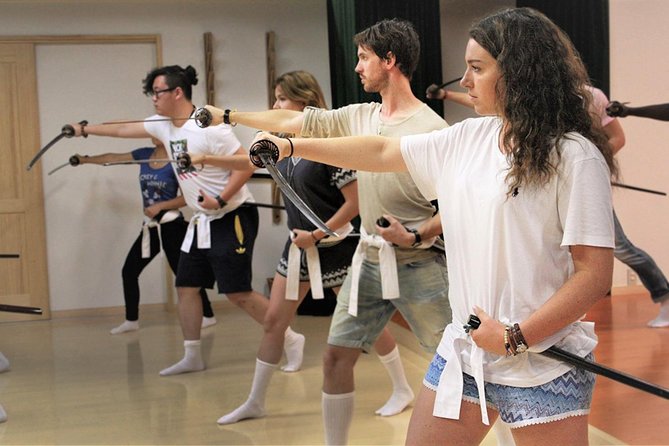
The most interesting part of this Kyoto activity is that you do not just watch samurai swordplay. You learn the formal bow, draw a sword, practice controlled strikes, and perform simple kenbu movements under an instructor’s direction. It is a practical taste of a traditional Japanese performing art, not a museum lecture.
I like the mix of hands-on sword practice and costume photography. I also like the small-group format, with a maximum of 10 people, since an instructor can see what you are doing and correct your movements. The main consideration is timing: the show or introductory material may take longer than expected, so do not schedule a tight appointment immediately afterward.
Key points to know
- You learn real kenbu basics: Practice bowing, drawing and sheathing a sword, striking, thrusting, walking, and using a folding fan.
- The costume is part of the lesson: You change into samurai clothing with a white belt and Japanese-style socks before the photo session.
- The performance adds useful context: Watching trained performers helps you understand why the movements require control and precision.
- The longer option offers more practice: An upgrade can include additional choreography, fan work, music, poetry, and a stage performance.
- The group stays small: The class allows no more than 10 participants, which suits families and first-time learners.
- You leave with keepsakes: The package includes photos, a completion certificate, and a tenugui traditional towel.
What Samurai for a Day Really Teaches You
Samurai for a Day is built around kenbu, a stylized Japanese sword performance art. You are not being trained for combat, and this is not a modern kendo practice. The lesson focuses on ritual, posture, choreography, and the careful handling of a sword.
That distinction matters. If you arrive expecting a long martial arts course, the basic session may feel brief. If you want a clear, entertaining introduction to samurai customs and sword movement, the format makes good sense.
You begin with a short film explaining basic samurai practices and the warrior class that shaped Japan from the 12th through the 19th centuries. The film is brief in the formal itinerary, but the complete session can include a performance that changes the pace. Some bookings finish in roughly 90 minutes, while others run a little over, so leave room in your schedule.
The instructor teaches in English, making the class easy to follow for international visitors. The teaching style is active and direct. You are shown a movement, then asked to repeat it. That keeps the lesson moving and gives you something to do instead of asking you to sit through a long talk.
More Samurai and Ninja Experiences in Kyoto
- Kyoto Samurai Experience
★ 5.0 · 1,294 reviews - Kyoto: Kendo and Samurai Experience with Uniform and Gear
★ 4.9 · 815 reviews - Kyoto: Samurai Sword Class by Experts in Traditional Arts
★ 4.9 · 657 reviews
Entering the Dojo in Kyoto’s Higashiyama Ward
The meeting point is at 35 Sanchome, Higashiyama Ward, Kyoto, near public transportation. You will enter the GOZAN building and go to the first basement floor using the stairs on the right side of the building.
This is the kind of arrival detail worth saving before you leave your hotel. Look for the building, then the correct stairs. The activity does not include hotel pickup or drop-off, so you handle your own route to and from the dojo.
Plan to arrive about 10 minutes before your start time. The arrival instruction also says to come between 10 minutes and 3 minutes before the lesson, so I would aim for the earlier end. You will need a little time to find the basement and get settled.
The venue is near public transportation, but the activity itself is indoors. That makes it a useful choice on a rainy Kyoto day, especially when temples and gardens are less pleasant. You should still wear clothes that let you move freely. A single hoodie or tight clothing is not suitable for changing into the costume.
The First Bow and the Samurai Uniform
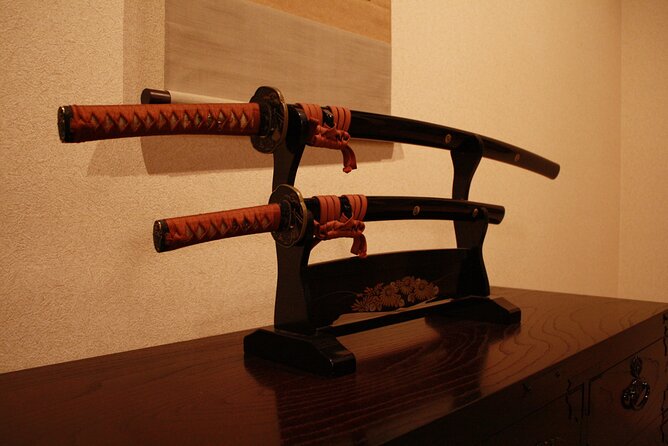
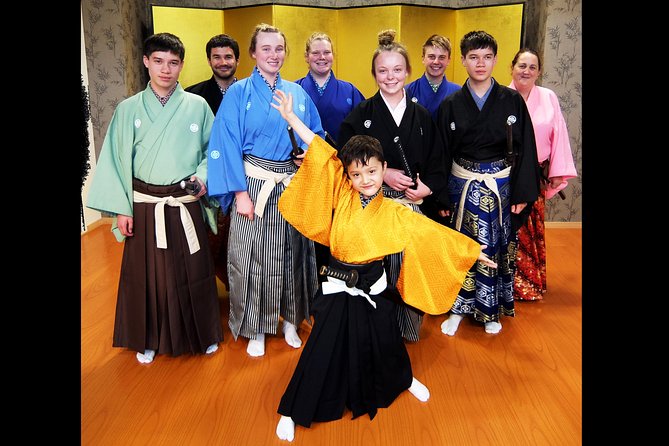
Once the class begins, you meet the English-speaking instructor and watch the short introductory film. Then you change into samurai-style clothing, including a white belt and Japanese-style socks, and receive a sword for the lesson.
Changing clothes does more than create a good photo. It marks a shift in the tone of the class. You are asked to stand, bow, and handle the sword with care rather than simply wave it around for fun. That formality is one reason this activity works better than a basic dress-up photo stop.
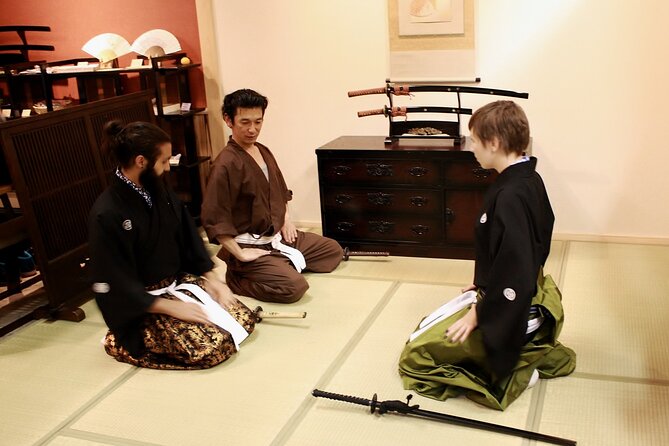
The instructor starts with the bow. This can seem simple, but it sets the rules for everything that follows. You learn to show respect before taking up the sword, and you finish the formal session with another bow.
Families should pay attention here. Children are allowed, but participants between ages 5 and 11 are preferably already attending a class or martial arts school. One review describes a strict response to mistakes made by young children, while other accounts praise the patient and friendly teaching. I would prepare children in advance: this is playful, but it still has rules.
Drawing, Sheathing, Striking, and Thrusting
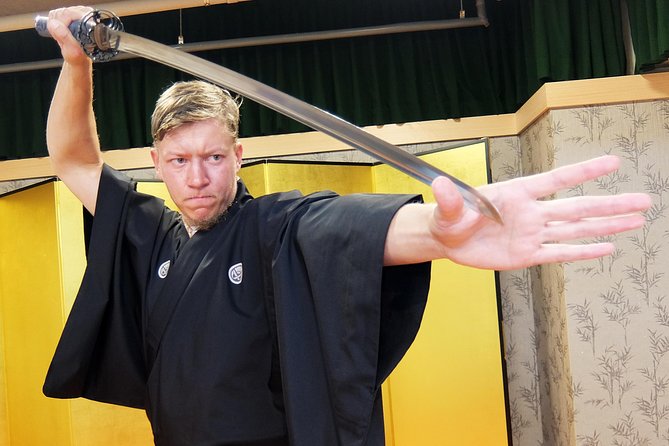
The most memorable part of the class is usually the sword work. You learn how to draw the sword from its scabbard and return it safely. The movement looks easy when performed by an expert, but coordinating your hands, posture, and timing takes concentration.
You then practice several types of strikes. The lesson can include thrusting and movements aimed at a potential opponent, always under the instructor’s safety directions. You should follow the teacher closely and avoid treating the sword as a toy.
The sword work is choreographed rather than free-form. That is good news for beginners. You do not need previous martial arts training for the standard class, although you do need moderate physical fitness and enough mobility to move around comfortably.
I especially like this section because it gives you a physical sense of discipline. Reading about samurai customs is one thing. Trying to draw a sword smoothly while keeping your stance and expression under control gives you a more useful memory.
The lesson is also accessible to family groups. A group of seven can take part together, and the maximum group size is 10. If your group is smaller, you may share the session with another couple or family. The exact feel depends on the size of the booking, but the small-group limit should prevent the class from becoming a large crowd.
More samurai and ninja sessions in Kyoto:
- Skip the lines Basic Ticket at SAMURAI NINJA MUSEUM KYOTO
★ 4.5 · 632 reviews - Ninja 1-hour Hands-on Lesson by Japanese master in Kyoto -Entry
★ 5.0 · 489 reviews - Kyoto: Ninja Weapon Forging Experience
★ 4.8 · 478 reviews - Kyoto: Samurai Kenbu Traditional Sword Dancing Show
★ 4.5 · 426 reviews
Costume Photos Without Losing the Lesson
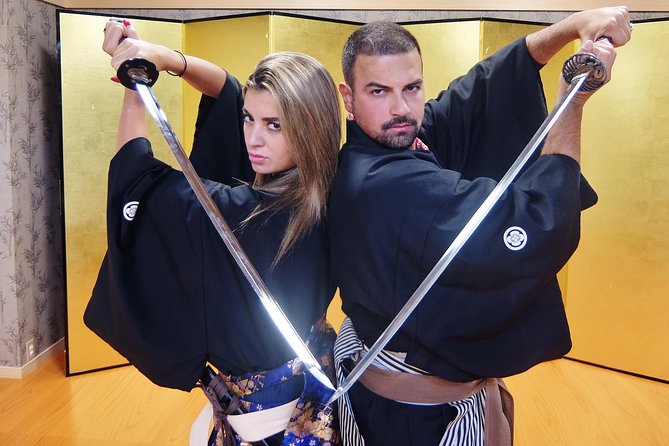
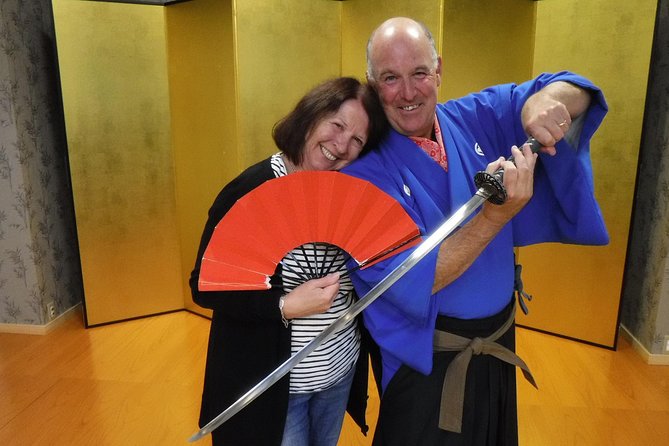
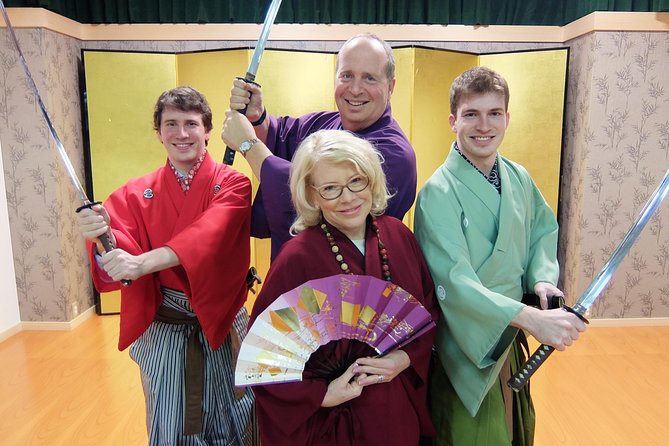
At some point during the training, you put on the traditional samurai costume for a photo session. You can pose with the sword, and the costume gives the pictures a clear sense of place and occasion.
I would treat the photo session as a souvenir, not a professionally staged portrait appointment. One account found the photography rushed, with little time for carefully posed pictures using a personal camera. If the photographs matter a great deal to you, have your camera or phone ready and know what pose you want before the session starts.
This is also why suitable clothing matters. You need an outfit that can be changed without fuss. Tight clothing or a single hoodie can make the costume change awkward.
The photos are included, along with a lesson completion certificate and a tenugui towel. The towel is a small but useful Japanese souvenir, while the certificate works well for children and anyone who enjoys collecting mementos from unusual activities.
The Performance and Why It Changes the Experience
The class may include a samurai performance by the staff. The show features trained performers using the same kind of controlled movement that you have just begun to practice. Seeing the finished form after handling the sword yourself can make the performance more meaningful.
The performance is widely praised for its skill and entertainment value. It can also affect your schedule. One account found the opening show much longer than expected, while others describe watching the show after the lesson as the best part of the afternoon. The order may vary by session or booking option.
The practical advice is simple: allow extra time at the end. The listed duration is about 1 hour and 30 minutes, but one booking ran over. Do not book a restaurant reservation, train, or timed attraction with no buffer.
The show is especially useful for adults who want more than a costume photograph. You see how a sword is used in performance, how music and poetry support the action, and how much control is required to make each movement look effortless. The longer option can take this further with stage choreography accompanied by a poem and music.
The Longer Lesson and Folding Fan Work
The standard session gives you an introduction to the bow, sword, costume, photos, and basic movements. If you want more practice, you can upgrade to a longer lesson.
The extra time may cover how a samurai walks, how to use a folding fan, and more detailed kenbu choreography. You may then perform the sequence on stage with a sword, music, and poetry.
This upgrade makes the most sense for martial arts enthusiasts, history buffs, teens, and adults who want to work on form rather than simply try the sword once. It also helps if your group enjoys performing and does not mind repeating movements until they are tidy.
For a casual family outing, the shorter option may be enough. Children and first-time participants often get the main appeal quickly: costume, sword, photos, and a show. For anyone who wants a stronger sense of the art itself, the longer session offers better value because you spend more time learning rather than changing clothes and taking pictures.
What the $66.32 Price Buys You
At $66.32 per person, this is not the cheapest indoor activity in Kyoto. The value depends on what you want from your afternoon.
You are paying for an English-language lesson, an instructor, costume use, sword practice, photos, a completion certificate, and a tenugui towel. The small group limit also matters. A private lesson would cost more, but a maximum of 10 people gives you a better chance of receiving personal corrections than a large stage attraction would.
The price is easier to justify if you value participation. You are not merely watching a performance. You handle the sword, learn the formal movements, dress for the occasion, and take home physical reminders.
It is less compelling if you only want a short show. In that case, the lesson may feel like more structure and practice than you expected. I would choose this activity for the combination of class and performance, not for the photos alone.
The 98 percent recommendation rate and 4.9 rating from 202 reviews point to consistently strong satisfaction, but the useful detail is in the pattern of praise: families like the hands-on format, couples enjoy the small groups, and martial arts fans appreciate the serious instruction. The recurring caution concerns timing and the rushed photo session.
Who Will Enjoy This Most
I would recommend Samurai for a Day to:
- Families with older children and teens who dislike long museum visits
- Couples looking for an unusual indoor activity
- Martial arts enthusiasts who want a brief introduction to kenbu
- History buffs who prefer practical learning to a lecture
- Visitors planning a rainy-day activity in Kyoto
- Small groups that want to take photos and learn together
The activity may be less suitable if you have limited mobility, dislike changing clothes, or want a purely passive show. Moderate physical fitness is requested, and you need to follow safety instructions closely.
Children aged 5 to 11 should ideally have some experience in a class or martial arts school. Older children and teenagers may appreciate the structure, especially if they enjoy role-play, performance, or Japanese history.
Booking and Timing Tips for a Smoother Visit
The ticket is mobile, and confirmation arrives at booking. You arrange your own transportation, and the activity ends back at the meeting point.
Wear exercise-friendly clothing that allows easy movement and costume changes. Arrive early enough to find the GOZAN building and basement entrance without rushing.
If you need to cancel, free cancellation is available up to 24 hours before the local start time for a full refund. Changes or cancellations made less than 24 hours before the start are not accepted for a refund.
Most important, keep your afternoon flexible. The show can make the event run longer than the advertised 90 minutes. If you are combining it with another Kyoto sight, put this activity before a flexible evening plan rather than between two fixed reservations.
Should You Book Samurai for a Day?
I would book it if you want to do something active and memorable in Kyoto. The lesson gives you a respectful introduction to samurai movement, while the costume, photos, certificate, towel, and performance make it easy to remember afterward.
The strongest reason to go is the combination of instruction and show. You first learn how difficult controlled sword movement can be, then watch skilled performers use those movements with far greater precision. That connection gives the activity more substance than a quick photo opportunity.
Choose the longer session if you care about choreography, fan work, or performing on stage. Choose the shorter option if your priority is a compact family activity with basic sword handling and pictures.
I would not book it with a tight schedule or if you expect a professional photo shoot. But for families, couples, teens, and curious first-time visitors, the $66.32 price is fair for a small-group class that gives you something to do, something to watch, and a few keepsakes to take home.
FAQ
How long does Samurai for a Day last?
The listed duration is approximately 1 hour and 30 minutes. Some sessions may run longer, particularly when a performance is included, so allow extra time afterward.
Where does the activity take place?
The meeting point is at 35 Sanchome, Higashiyama Ward, Kyoto, near public transportation. Enter the GOZAN building and go to the first basement floor using the stairs on the right side.
Is the class taught in English?
Yes. An English-speaking local guide or instructor leads the activity.
What will I learn?
You learn how to bow, draw and sheathe a samurai sword, perform basic strikes and thrusts, and practice stylized kenbu movements. The longer option can also include walking, folding fan work, and more advanced choreography.
Do I get to wear a samurai costume?
Yes. You change into traditional samurai-style clothing, including a white belt and Japanese-style socks, for the lesson and photo session.
Are photos included?
Yes. A photo shoot is included. The available information does not promise a professional photography service, so bring your own camera or phone if you want additional pictures.
What do I receive after the lesson?
You receive photos, a lesson completion certificate, and a tenugui, which is a traditional Japanese towel.
Is the activity suitable for children?
Children can participate, but those between ages 5 and 11 are preferably attending a class or martial arts school. All participants need to follow the instructor’s safety directions and have moderate physical fitness.
Can I cancel for a full refund?
Yes. You can cancel at least 24 hours before the experience’s local start time for a full refund. Cancellations or changes made less than 24 hours beforehand are not accepted for a refund.
Just added around Kyoto
- Kyoto: Zen Meditation at a Private Temple with a Monk★ 5.0 · 25 reviews
- Kyoto: Gion Geisha District & Sake-in-Hand Walking Tour★ 5.0 · 37 reviews
- Private Pewter Sake Cup Experience with a Kyoto Artisan★ 5.0 · 31 reviews
- Your Private Vacation Photography Session In Kyoto★ 5.0 · 110 reviews
- Private Guided Traditional Buddhist Cooking in Japan★ 5.0 · 16 reviews
- Kyoto Wagashi(Japanese sweets) Cooking Class near Fushimiinari★ 5.0 · 60 reviews
- Traditional Japanese Music show & Experience Tour in Kyoto★ 5.0 · 57 reviews
- Kyoto:Family-Friendly Kimono & Yukata Experience at WARGO★ 5.0 · 147 reviews
Kyoto Tours, compared.


Fushimi Inari, Kinkakuji, Bamboo Grove 1 Day Bus Tour
Read our review →
Tea Ceremony in a Traditional Tea House in Kiyomizu
Read our review →
Kyoto Geisha Walking Tour: Gion District & Hidden Gems
Read our review →

Gion Magical Night Walking Tour with Geisha Trivia
Read our review →

Gion Geisha District Walking Tour – Stories of Geisha
Read our review →Browse the lists this tour appears in